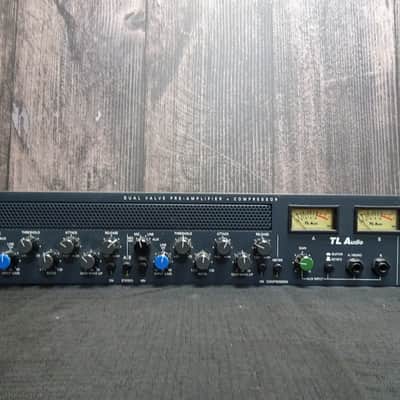
TL Audio Classic C-1 Dual Valve Pre-amplifier Compressor.


TL Audio Classic C-1 Dual Valve Pre-amplifier Compressor.
This seller has not set a shipping cost for Continental U.S.. Please contact them to ask about shipping.

Our users rate Reverb
The Classic range, like the Ivory series and the Indigo before it, employs a coalition of both solid‑state and valve components in carefully designed hybrid circuits, the aim being to combine the best of both worlds. TL Audio claim that this approach enables their signal processors to deliver superb sound quality, high technical specifications, and rugged real‑world interconnectivity — a combination which eludes many vintage valve units!
The majority of the Classic and Ivory ranges use the ever‑popular 12AX7A/ECC83 twin‑triode valve for voltage amplification stages, positioned strategically in the signal path where the benefits of valve circuitry are most apparent. However, the microphone and line inputs, line outputs, and various other sections of the circuitry are fabricated from conventional solid‑state components. Apparently this design approach helps to achieve the kind of technical specifications demanded of a modern piece of studio equipment — operating noise figures better than ‑80dBu, distortion better than 0.05%, and frequency response flat within 1dB from 10Hz to 40kHz.
In place of traditional signal transformers linking the valve amplifiers with the rest of the circuitry, transistorised buffer stages allow better noise figures, lower distortion, faster slew rate and a lower shipping weight! The Classic range also uses relatively high anode plate (HT) voltages of around 250V to further lower the noise floor and extract the best possible performance from the selected valves (the Ivory series uses a lower 150V HT rail).
The standard of construction is hard to fault. High‑quality fibreglass printed circuit boards with over‑specified components are used throughout, and the case is made of strong folded and welded steel with a tough paint finish. Although the control pots and connectors are all mounted directly on the main or daughter PCBs, they are mechanically secured either to a sub‑chassis or the external case, so it's unlikely that any mechanical strain would be transferred to the circuit boards.
The comments above apply to all the Classic range devices. In the case of the C1 dual compressor, the balanced mic and line inputs are accommodated by the familiar SSM2017 audio preamplifier chip, and NE5532 dual op‑amps handle the guitar/keyboard inputs on the front panel, as well as driving the balanced line‑level outputs. One of the ECC83 valves provides a voltage amplification stage prior to the compressor, and the remaining circuitry is built around TL074 quad op‑amps. The core of the compressor — the VCA — is based on an LM13600 transconductance amplifier with the second ECC83 valve as an integral part of its signal path. In the review model, the valves were selected American GE types.
Reverb Buyer Protection
Reverb has your back if your item is lost, damaged, or doesn't match its description. Simply report any issues within 7 days and we'll help you get a full refund.Learn more about Reverb Buyer Protection.
| Listed | 17 days ago |
|---|---|
| Condition | Excellent (Used) Excellent items are almost entirely free from blemishes and other visual defects and have been played or used with the utmost care.Learn more |
| Brand | |
| Model |
|
| Categories |
Product safety information may be available here.

