1969 Fender Jazz Bass – James Brown / Bootsy Collins / Fred Thomas Provenance
Dieses Equipment wurde verkauft
Ähnliches Equipment von anderen Reverb-Verkäufern ansehen

Unsere Benutzer bewerten Reverb
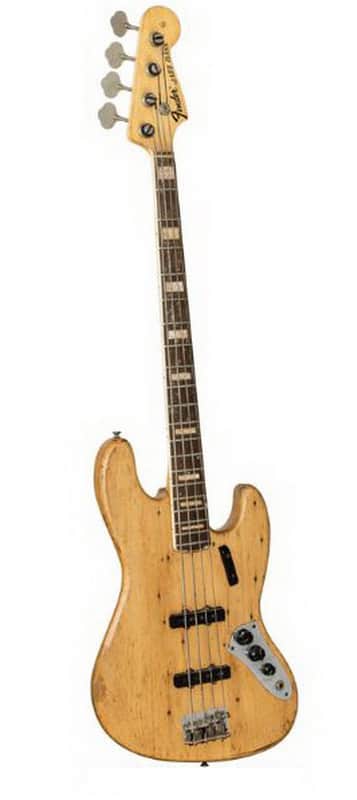
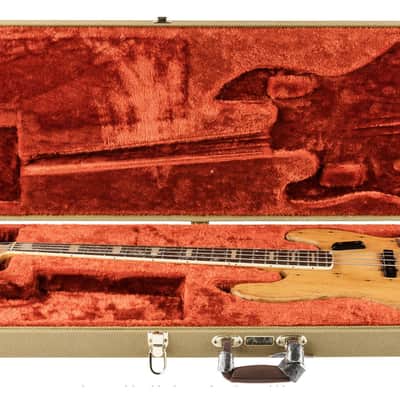
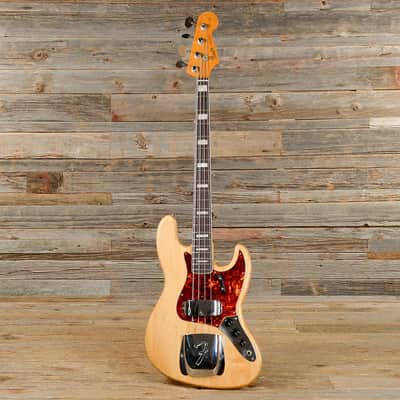
This 1969 Fender Jazz Bass, serial number 266610, is a historically significant instrument directly tied to the genesis and evolution of modern funk music. According to documented records and affidavits included in the sale, the bass was purchased by James Brown circa 1970 for his newly hired bassist William “Bootsy” Collins. During Collins’s brief but pivotal tenure with Brown’s band, the J.B.’s, the instrument served as one of the foundational tools that shaped the early development of the funk sound. Bootsy’s innovative approach to timing, phrasing, and rhythmic interplay transformed the role of the bass in contemporary music, and this instrument stands as a surviving witness to that creative revolution.
Following Bootsy Collins’s departure in 1972, the bass remained in the James Brown organization and was placed into the hands of Fred Thomas, Brown’s longtime bassist and a central contributor to the group’s defining 1970s sound. Thomas used this instrument extensively on stage and in studio sessions throughout the mid-1970s, including performances and recordings associated with landmark funk compositions such as “Hot Pants,” “Make It Funky,” “Papa Don’t Take No Mess,” “Get On the Good Foot,” and “Pass the Peas.” Thomas’s precise, pocket-driven approach helped refine and solidify the rhythmic doctrine of “the One,” cementing his place as one of funk’s most important and influential bassists.
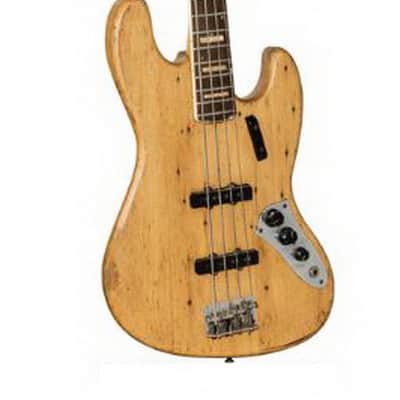
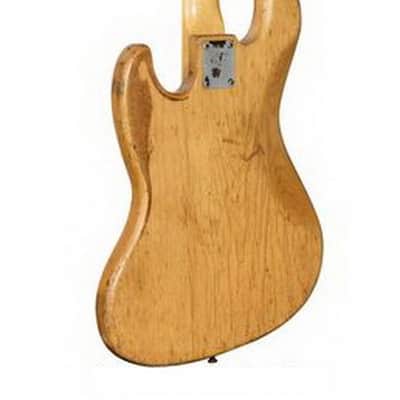
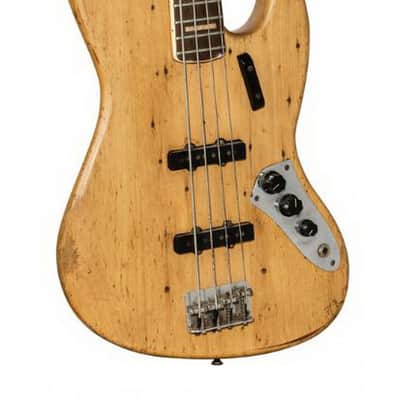
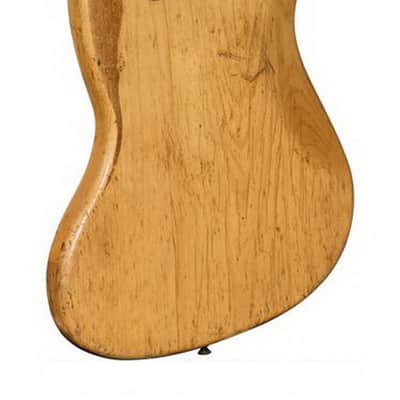
The instrument’s physical evolution reflects its decades of continuous professional use. Originally finished in Fender’s three-tone sunburst, the bass underwent a distinctive cosmetic transformation during the late 1970s disco era, when decorative contact paper was applied over the entire body. This period saw many touring musicians adopting flashy, reflective, or stylized visual elements to suit the changing aesthetic demands of the stage, and covering instruments with contact paper became a practical, inexpensive way to achieve a new look without interrupting performance schedules. The adhesive covering remained on the bass for years, and when it was eventually removed, significant portions of the original finish were lifted off with it. To restore the instrument to a playable and visually cohesive state, the remaining finish was sanded down, resulting in the natural-wood appearance it retains today. Rather than diminishing its value, this transition from sunburst to natural stands as an authentic testament to the instrument’s heavy use, evolving musical environments, and the hands-on practicality of life in James Brown’s touring ensemble.
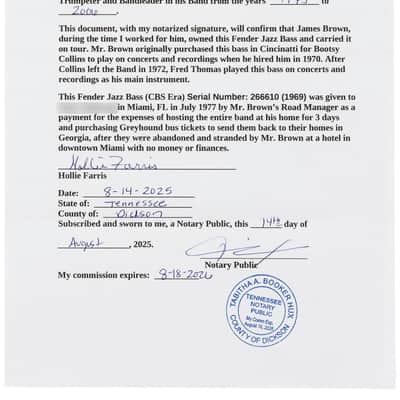
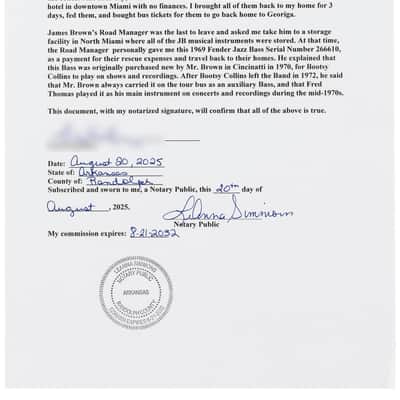
The bass comes with complete documentation, including a signed affidavit from band member Hollie Farris affirming its chain of custody within the James Brown ensemble and its use by both Collins and Thomas. It was subsequently acquired by Joseph Stinson, former professional bassist and proprietor of Stinson & Company, a respected pawn and fine collectibles firm based in Portland, Maine. Prior to his career as a dealer, Stinson served as a regional bass player throughout New England in the late 1990’s to early 2000’s, performing with the bands 3 More Bullets, Bolt Cutter, and Boomslang. His background as both a bassist and a collector positions him as an ideal steward of an instrument of this magnitude.
As of its transfer to Joseph Stinson, this 1969 Fender Jazz Bass is preserved as a culturally significant artifact representing the lineage of three major figures in American music: Bootsy Collins, whose early work redefined the voice and personality of the electric bass; Fred Thomas, whose disciplined, groove-centered playing became the architectural foundation of James Brown’s 1970s sound; and James Brown himself, the Godfather of Soul, whose innovations shaped the trajectory of funk, R&B, and popular culture. The instrument now resides in the Stinson & Company collection, maintained under professional archival standards to ensure its ongoing preservation for future study, exhibition, and documentation.Item pictured is the item you will receive.
Reverb-Käuferschutz
Reverb hilft dir weiter, wenn dein Artikel verloren geht, beschädigt ist oder nicht der Beschreibung entspricht. Melde alle Probleme einfach innerhalb von 7 Tagen und wir verhelfen dir zu einer vollständigen Rückerstattung.Erfahre mehr über den Reverb-Käuferschutz.
| Inseriert | vor 4 Monaten |
|---|---|
| Zustand | Gut (Gebraucht) Artikel mit Zustand Gut funktionieren einwandfrei, können aber einiges an Makeln oder Spielspuren aufweisen.Weitere Informationen |
| Marke | |
| Modell |
|
| Farbe |
|
| Kategorien | |
| Jahr |
|
| Hergestellt in |
|
| Serie | |
| Griffbrettmaterial |
|
| Modellreihe | |
| Rechts-/Linkshändig |
|
| Aktive/passive Tonabnehmer |
|
| Halsmaterial |
|
| Korpusform |
|
| Aktiver Vorverstärker |
|
| Anzahl der Saiten |
|
| Offset-Körper |
|
| Tonabnehmerkonfiguration |
|
| Farbfamilie |
|
| Anzahl der Bünde |
|
Möglicherweise sind hier Informationen zur Produktsicherheit verfügbar.