


MOTU 2408 MK3 Audio Interface

Predicted to Sell Soon
Only 1 available and 1 other person has this in their cart


Our users rate Reverb
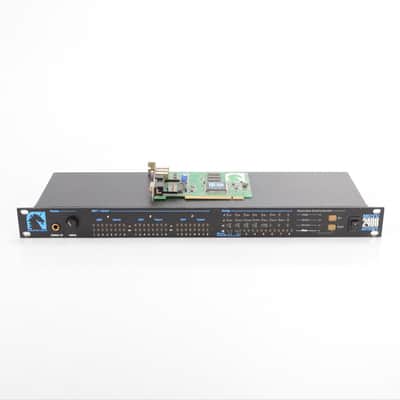
The 2408 MK3, as the name suggests, is the third incarnation of this popular interface, which offers a combination of connection protocols and metering options. The numerical designation refers to the fact that it offers 24 channels of simultaneous I/O, eight channels of which can be analogue.
The rear panel, from left to right, sports the following connectors:
- Word clock in and out. The Word in socket also doubles as a Video input allowing the interface to resolve directly to a video signal.
- S/PDIF. There is one stereo input and two stereo outputs. The second output simply duplicates the output of the first and allows the connection of a further digital device such as a DAT machine. These sockets also double as SMPTE timecode input and output, and the second output will still deliver S/PDIF digital audio even when SPMTE in and out are required.
- TDIF connectors. There are three 25-pin 'D' connectors, each of which handles eight channels of digital I/O. These share the output with the ADAT optical outputs, although the inputs can only be one or the other.
- The Audiowire socket for connection to the PCI-424 card.
- Three pairs of ADAT optical connectors for up to 24 channels of ADAT digital I/O.
- Two rows of eight quarter-inch balanced jack sockets for eight channels of analogue I/O.
- One pair of balanced quarter-inch jack sockets for main output. These duplicate the output of analogue channels 1 and 2, if one of the three eight channel banks into which the 2408 Mk3 is internally divided has 'analogue' selected as the desired format (using the PCI-424 configuration window).
The front panel is very clearly laid out, considering the large amount of information that the 2408 Mk3 needs to present. At the far left is a headphone jack with its own volume control, next to the main output volume control. Next come three sets of LEDs, which display input and output activity for each channel of the three banks of digital I/O. To their right is the metering for the analogue I/O. This is handled by five-segment LED meters measuring from -42dB up to 0dB. When the 2408 Mk3 is running under computer control rather than in stand-alone mode, these LEDs also operate as clock source indicators, a mode chosen by pressing the Select button. I should point out that I found the LED indicator legend extremely difficult to read if, for example, I needed to check the indicated sample rate. This was also the case for the three rows of stand-alone settings indicators — a case of too much information for such a compact space.
Reverb Buyer Protection
Reverb has your back if your item is lost, damaged, or doesn't match its description. Simply report any issues within 7 days and we'll help you get a full refund.Learn more about Reverb Buyer Protection.
| Listed | 7 days ago |
|---|---|
| Condition | Very Good (Used) Very Good items may show a few slight marks or scratches but are fully functional and in overall great shape.Learn more |
| Brand | |
| Model |
|
| Categories | |
| Bus-Powered |
|
| Sample Rate |
|
| Digital Input Format |
|
| Electronics |
|
| Digital Output Format |
|
| Compatibility |
|
| Computer Connectivity |
|
| Bit Depth |
|
| Format |
|
| Simultaneous I/O |
|
| Number of Headphone Outputs |
|
| Number of MIDI Outputs |
|
| Number of MIDI Inputs |
|
| Number of Digital Outputs |
|
| Number of Digital Inputs |
|
| Number of Analog Outputs |
|
| Number of Analog Inputs |
|
| Number of Channels |
|
| Number of Mic Preamps |
|
Product safety information may be available here.

