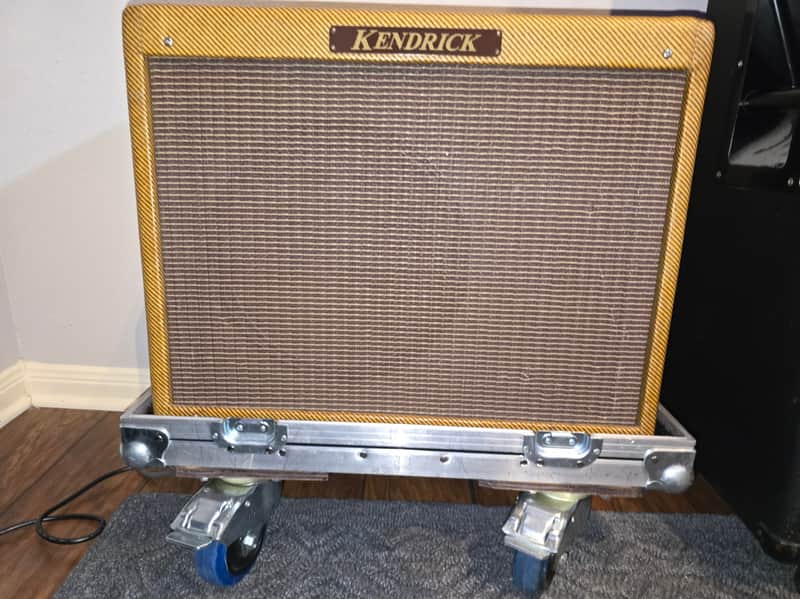
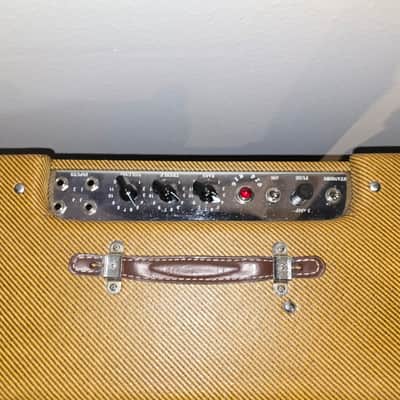
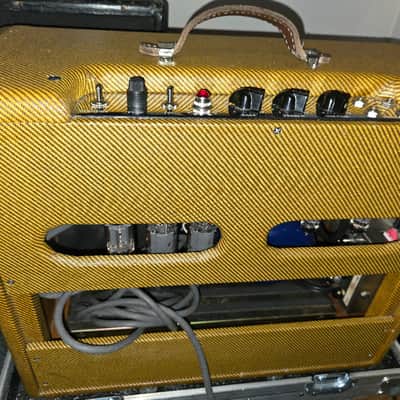
Kendrick Gig Rig Tweed 35 watts

Our users rate Reverb
The Kendrick Gig Rig is a boutique, hand-wired all-tube guitar amplifier designed and built by Gerald Weber of Kendrick Amplifiers. Comes in a custom road case
Key Specifications
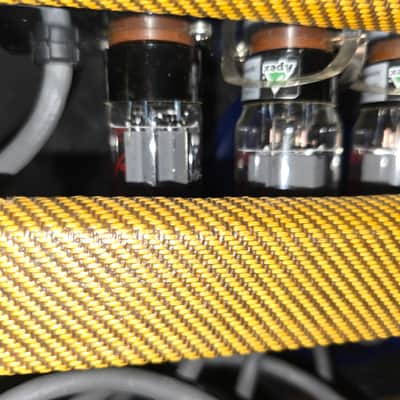
- Power Output: Typically 35 watts (powered by 6L6 or 5881 power tubes), though 50-watt variations exist.
- Cabinet: Constructed from lightweight, highly resonant 100-year-old antique pine.
- Reverb: Features a 3-knob, tube-driven internal onboard reverb unit.
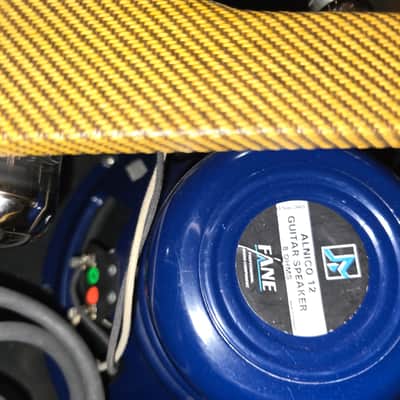
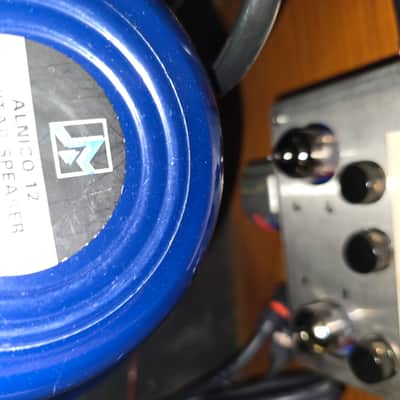
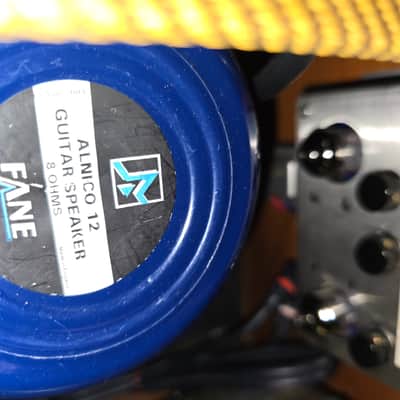
- Speaker: Often paired with high-end Fane Alnico or Kendrick Black Frame speakers.
Tone and Performance
- The Sound: It acts as a sonic cross between a vintage Fender Deluxe Reverb and a Tweed Deluxe, offering a warm touch and great dynamic response.
- Headroom: It is voiced to stay remarkably clean and clear at higher volumes before breaking into a smooth, natural overdrive.
- Evolution: Over time, the design of the Gig Rig was refined and officially renamed by the manufacturer as the K Spot amplifier.
Kendrick Gig Rig/K spot
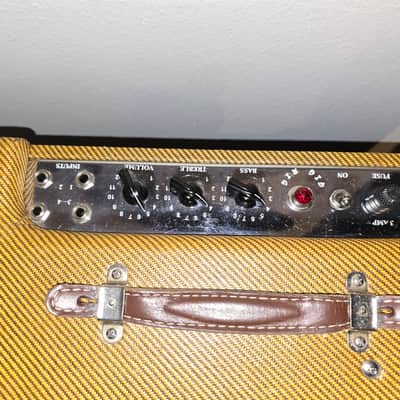
The four inputs on a Kendrick Gig Rig amplifier do not allow for channel jumping; instead, they feature varying degrees of padding (signal attenuation) to shape the amp's overall character and accommodate different guitar outputs.
- Input 1: The brightest, most dynamic input with no padding. It yields maximum bite and high-end clarity.
- Input 2: Slightly less bright than Input 1 with a very mild pad.
- Input 3: Features more padding to tame hot signals and smooth out the top end.
- Input 4: The darkest and most padded input. It is ideal for taming extremely high-output humbuckers or preventing unwanted distortion.
The Volume, Bass, and Treble controls on a Kendrick Gig Rig amplifier operate via a simple, interactive, vintage-style circuit. Designed to be highly responsive to pick dynamics, they behave more like an instrument than a traditional, sterile 3-band EQ.
- Volume: Controls the overall output and gain. At lower levels (up to 3-4), the amp delivers thick, clean tones. As you roll the volume past noon, the 6L6 power tubes and 12AX7 preamp tubes naturally compress and overdrive, taking the amp into tweed-on-steroids territory.
- Bass: A low-frequency shelving filter that controls the "thump" and fullness of your sound. Turning it up adds deep, resonant body (which pairs perfectly with the amp’s antique pine cabinet), while turning it down tightens the low-end for a punchier, articulate tone.
- Treble: A high-frequency shelving filter that controls the "bite," presence, and cut. Turning it clockwise adds chime and jangle, while turning it counter-clockwise warms up the tone and tames ice-pick frequencies.
Because this is a classic, highly interactive tone stack, the controls affect one another. For example, boosting the bass heavily will cause the amp to break up into distortion faster as you turn up the volume.
The Kendrick amplifier’s 3-knob tube reverb is a dedicated, all-tube spring reverb circuit. It mirrors the design of classic outboard 1960s Fender units, utilizing a dedicated preamp tube to drive the signal into a physical spring pan and another to recover it.
It uses three distinct controls:
- Dwell: Adjusts the intensity of the signal driving the springs. Higher Dwell settings result in a harder hit on the springs, yielding a thicker, more compressed, and explosive reverb trail.
- Tone: Shapes the high-frequency content of the wet reverb signal. It allows you to brighten the echoes for a "splashy" surf sound or darken them to sit warmly behind your dry guitar tone without getting harsh. [1, 2]
- Mix (or Reverb): Controls the wet/dry balance. It determines how much of the reverb signal is blended into your clean (dry) amplifier signal, allowing you to dial in anything from subtle room reflections to massive, cavernous ambience. [1]
Adjust the Kendrick 3-knob tube reverb (Dwell, Tone, Mix) by treating it like a standalone 1960s Fender unit. Dwell controls the decay length and signal strength into the tank, Tone brightens or darkens the reverb reflections, and Mix balances the wet/dry signal.
Specific style settings include:
- Classic Country / Rockabilly: Set the Mix low (9 o'clock) for a subtle "slap" enhancement. Use a moderate Dwell (11 o'clock) and a brighter Tone (2-3 o'clock) so the reverb doesn't drown out rapid flatpicking.
- Surf / Ambient: Maximize your spacey, splashy tones by cranking the Mix (3 o'clock+) and Dwell (2-4 o'clock). Roll the Tone back slightly (11 o'clock) to keep the extreme wet signal from sounding harsh or ice-picky.
- Blues / Classic Rock: Keep the Mix low (9-10 o'clock) to avoid muddying up your guitar's natural midrange grit and overdrive. Set Dwell low to moderate (9-11 o'clock) with the Tone at noon to add natural 3D depth without washing out your lead notes.
The Gig Rig features a highly responsive tube circuit hand-built by Kendrick Amplifiers. You can safely fine-tune these parameters while playing to hear how the springs react to your pick attack.
Reverb Buyer Protection
Reverb has your back if your item is lost, damaged, or doesn't match its description. Simply report any issues within 7 days and we'll help you get a full refund.Learn more about Reverb Buyer Protection.
| Listed | a day ago |
|---|---|
| Condition | Excellent (Used) Excellent items are almost entirely free from blemishes and other visual defects and have been played or used with the utmost care.Learn more |
| Brand | |
| Model |
|
| Finish |
|
| Categories | |
| Year |
|
| Made In |
|
Product safety information may be available here.

