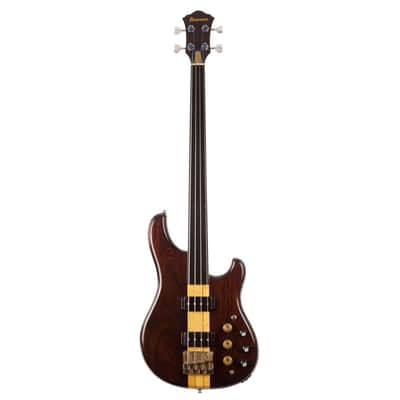
IBANEZ MC 940 FRETLESS 1980-84 - WALNUT

Ibanez Musician MC-940 — what it is
The MC-940 was the fretless flagship of the early Musician bass range, produced in Japan roughly 1980–1984. The Musician line itself began around 1979, and the MC-940 appeared alongside models such as the MC-824 and MC-924.
It was a very serious instrument for its day:
- 34” scale
- Fretless ebony fingerboard
- Neck-through construction
- 5-piece maple/walnut neck
- Early examples: mahogany body with bookmatched ash top
- Later examples: solid ash body
- 19 mm string spacing
- Gold-plated Accu-Cast bridge
- Two powerful Ibanez Super pickups
- Sophisticated active/passive electronics
- 3-band EQ
- Japanese construction
The original U.S. list price was around $790 in 1980, which was substantial money at the time.
The really interesting part: construction
The MC-940 isn’t simply an inexpensive Japanese Fender alternative. Its neck-through, multi-laminate neck and ebony fretless board put it much closer conceptually to the high-end instruments coming from companies such as Alembic and other boutique builders at the time.
The 5-piece maple/walnut neck was marketed around Ibanez’s “Tune Response” concept. The construction gives the instrument a very immediate attack and a lot of sustain, while the fretless ebony board contributes to the characteristic smooth response.
The early MC-940s are particularly attractive because of their bookmatched ash tops over mahogany.
Electronics
This is where the MC-940 gets particularly unusual.
1980–81
The earliest version used two Super 4 Alnico single-coil pickups.
It had an active/passive system with:
- Master volume
- Master tone
- Boost/cut
- Bass
- Mid
- Treble
- EQ on/off
The electronics run from a 9V battery, and the bass uses a ¼” stereo output jack.
That gives you considerably more tonal control than you’d expect from a conventional passive fretless bass.
1982 onward
Ibanez changed the pickup arrangement to:
- Super P-5 — neck
- Super J-5 — bridge
So the later MC-940 is essentially moving toward a P/J-type pickup architecture while retaining the Musician’s sophisticated active circuitry. The bridge was subsequently updated to the Accu-Cast B II.
This is important when identifying one: an MC-940’s year can make a surprisingly large difference to what’s underneath the hood.
The Sting connection
This is probably the most famous MC-940 story.
Sting used a custom MC-940 with The Police.
According to the documented gear history, Sting received a custom pearl-white MC-940 in January 1981 while The Police were touring Japan. His instrument differed from the standard production bass: it had a maple fretless neck and two Super P-5 pickups.
And that’s a particularly interesting detail because the MC-940 is strongly associated with The Police’s early-’80s sound and imagery.
The instrument is documented in connection with Zenyatta Mondatta and is particularly recognizable in footage/photos surrounding “Message in a Bottle.”
There is therefore a slightly misleading piece of folklore surrounding the bass: Sting’s instrument is often simply called an “MC-940,” but it was not necessarily identical to a stock MC-940 hanging in an Ibanez dealer’s shop. It appears to have been a custom configuration.
One important historical point
The MC-940 is sometimes described as a 1979 model, because Musician catalogs from the period can create some confusion around when individual models appeared. The surviving catalog/price-list evidence shows the MC-940 in the early Musician documentation, while the detailed model specification generally identifies 1980–1984 as its production period.
Ibanez itself maintains an archive of historical catalogs, which is one of the best primary sources for sorting out these year-to-year differences.
The MC-940 is not just a vintage Japanese curiosity. Technically, it’s an unusually ambitious bass for 1980.
neck-through + multi-piece maple/walnut neck + ebony fretless board + active 3-band electronics + custom-quality pickup options
That’s why I would put it in the high-end Japanese bass category rather than lumping it in with ordinary Matsumoku-era copies.
And the Sting connection is particularly significant: the MC-940 was one of the Japanese instruments that helped demonstrate that Ibanez could make an instrument that serious professional players could take onto a major international stage.
Reverb Buyer Protection
Reverb has your back if your item is lost, damaged, or doesn't match its description. Simply report any issues within 7 days and we'll help you get a full refund.Learn more about Reverb Buyer Protection.
| Listed | 23 days ago |
|---|---|
| Condition | Excellent (Used) Excellent items are almost entirely free from blemishes and other visual defects and have been played or used with the utmost care.Learn more |
| Brand | |
| Model |
|
| Finish |
|
| Categories | |
| Year |
|
| Made In |
|
| Finish Style |
|
| Color Family |
|
| Right / Left Handed |
|
| Active / Passive Pickups |
|
| Neck Material |
|
| Active Preamp |
|
| Frets |
|
| Number of Strings |
|
| Fretboard Material |
|
| Body Shape |
|
| Model Family |
|
| Scale Length |
|
Product safety information may be available here.