

Mijas, España
Información sobre este anuncio
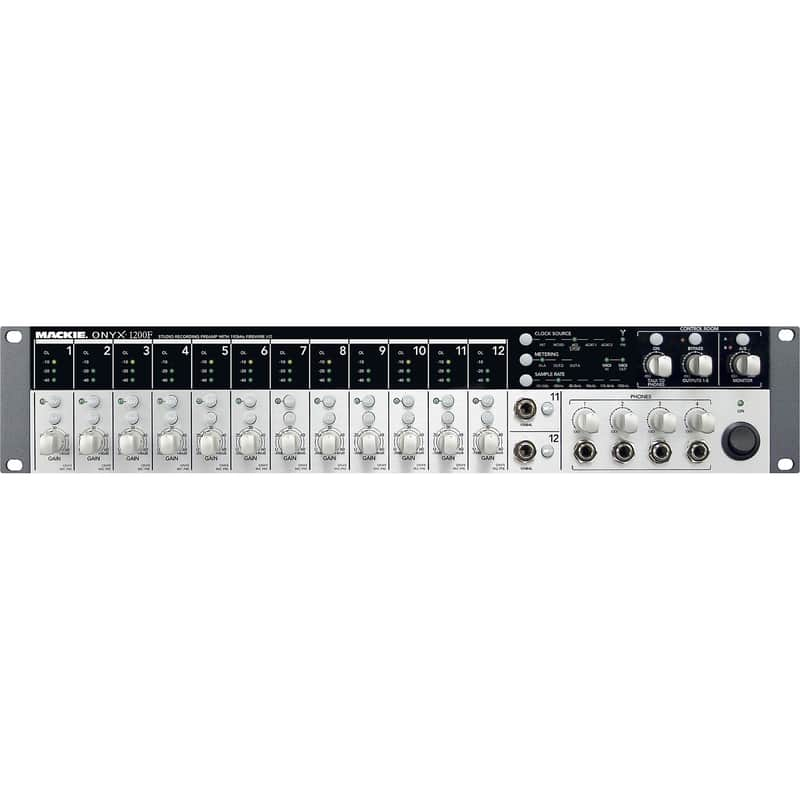
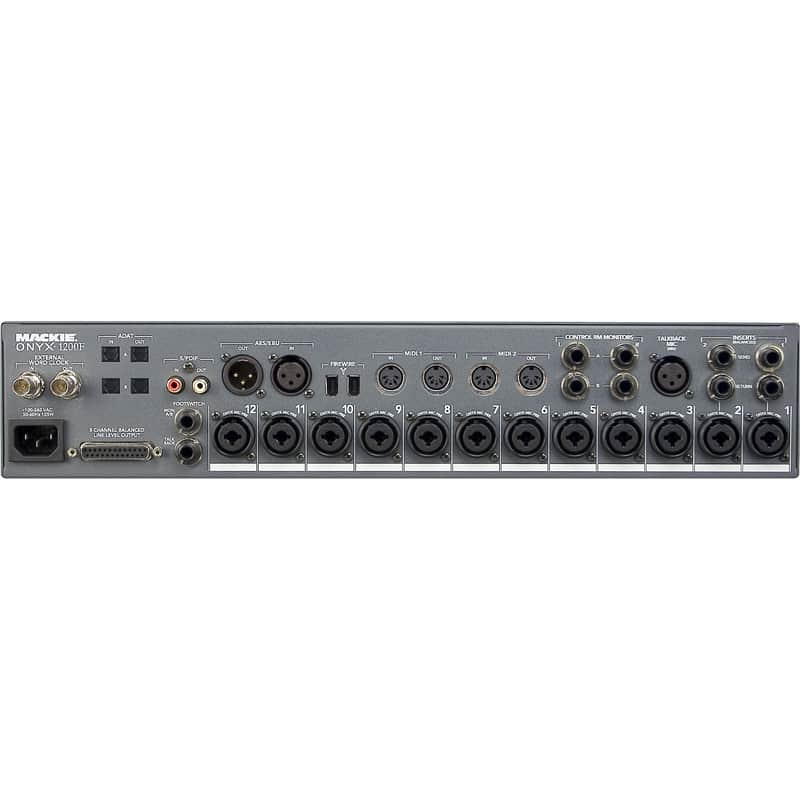
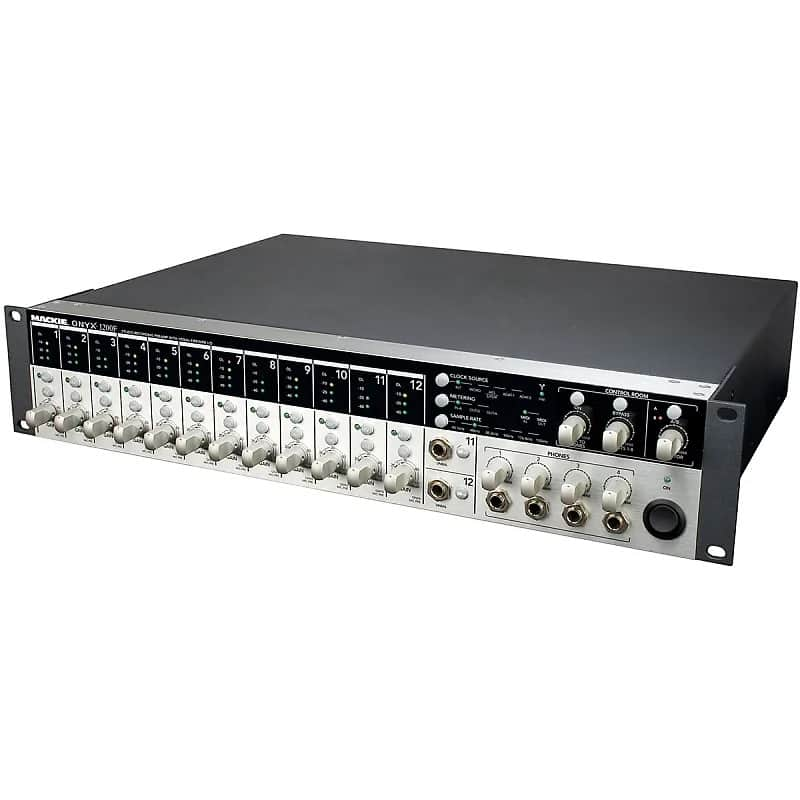
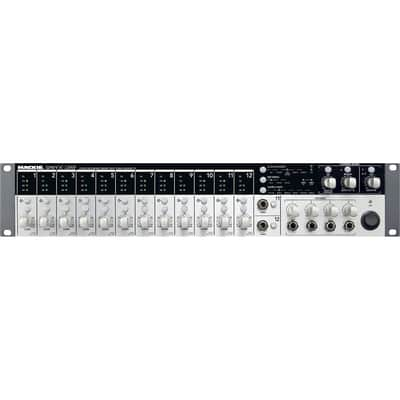
Brand New! –Closed BoxWe are authorised dealers of thefinest audio gear and musical instruments. Note 1: Freeshipping within EU. For specific shipping rates outside Europe please messageus.Note 2: Thisproduct is sent factory direct, please allow 10 to 15 days for shipping. MACKIE ONYX 1200FStudio Recording Preamp and 192kHz FireWire Interface 12 premium Onyx preamps, 30 inputs, 34 outputs, andmastering-quality conversion.The Mackie Onyx 1200F FireWire Audio Interface isquite simply a monster. It boasts 30 total inputs (yes, 30!) and 34 outputs.Twelve of these inputs are premium-grade Onyx mic/line preamps, enough to tracka complete live band all in a single pass. On the output stage, you've got 8discrete analog outs for surround mixing, or to mix down discrete mix"stems." The 1200F also boasts the most fully equipped monitoring andsignal-routing architecture you'll find in a recording interface, with 4 individualheadphone outs, flexible control room options, and a fully customizable signalrouting matrix. The Onyx 1200F is also loaded with comprehensive digital I/O(AES/EBU, S/PDIF, 16 channels of ADAT Optical), WordClock, dual MIDI I/O jacks,Talkback, balanced sends/returns... pretty much anything you can imagine--andeverything you'll need--is there.It's a multi-media, multi-platform, multi-format, multi-channel world. Younever know what new challenge will walk through your studio door. The lastthing you want is to say those dreaded words: "I can't do that." Youneed to be ready for anything. So Mackie gives you everything.While the 1200F preamp's specs may be ambitious, that's only half the story.The Onyx also has to sound phenomenal. In addition to its pristine Onyx signalpath, the 1200F is fully HD ready, with mastering-grade AKM 24-bit/192 kHzdigital converters. Of course all this wouldn't mean a thing if the Onyx 1200Fdidn't have that signature Mackie legacy of quality craftsmanship, reliability,affordability, and intuitive ease of use.The Onyx 1200F FireWire audio interface brings everything together into asingle, harmonious system to meet any challenge that comes your way.Full Studio IntegrationTake a look at the back of the Onyx 1200F and you'll see just how much powerMackie packed into the thing. Thirty total inputs. Thirty-four total outputs.Twelve Onyx mic/line preamps. Word Clock, ADAT I/O, AES/EBU, S/PDIF, MIDI,FireWire, Talkback and monitor footswitches, dual control room outs, balancedinserts. The whole enchilada.Flip it back around to the front panel and you'll see the real magic of the1200F. Rather than just give you the universe and leave it up to you to masterit, Mackie made things easy. Nearly every back-panel feature is matched by aneasy-to-use front-panel control. Not only do you have power at your fingertips,you've got the ability to make sense of it in the blink of an eye.Despite its easy operation, there is some serious depth at work with the Onyx1200F. Underneath the hood is a powerful onboard DSP Matrix Mixer that allowsyou to connect any input to any output with near-zero latency. This true64-bit, floating-point DSP matrix is an industry first that results infantastic sound and massive routing flexibility. Even better, this powerfulrouting architecture is stored into the 1200F itself. When you flip on the1200F, you have total recall of all your custom settings. This means you canalso use the 1200F in standalone mode, without the need for a computer. Yourwhole studio is right there, inside the box, which means that your recordingsystem can go anywhere you do--whether that's in the studio or out on the road.This combination of capability, customization, and intuitive use is importantin meeting the demands of today's vast recording possibilities.Room to Spare: The Ins and Outs of the Onyx 1200FWith any other recording interface, you'll be lucky to get eight individualanalogue input channels. While this might work if you're overdubbingeverything, let's say a band or producer tells you he wants to track the bandlive. With some other interface, you may only get as far as the drumkit beforeyou realize you've run out of mic channels. At this point, you're talking aboutgoing direct with the guitar and people are giving you that polite sneer,thinking about where else they can go to do what they need to do.With the 1200F's twelve Onyx mic preamps, you're in good shape. Mic up thatkit, the guitar cabinet, the percussion player, the sax, even the bassist if hedoesn't want to go direct. You're ready. If you find you do need directsignals, channels 11 and 12 also have front-panel Hi-Z instrument jacks. Nodirect boxes required. With the 1200F, not only do you have the channels youneed, you've got flexibility as well.Mackie has gone similarly overboard on the output stage. The Onyx 1200F houseseight discrete analogue output channels on 25-pin D-Sub connectors. Thesebalanced output connectors conserve valuable real estate and help to keep thecable spaghetti to a minimum. Multiple outputs have a variety of uses. Ifyou're a surround mixer, you can use the Matrix Mixer to store custom outputpath assignments all the way up to 7.1 mixing. You can also send analoguesignals via stems to do an analogue mixdown. Or you could send these outs todifferent recorders and other devices.Any serious recording studio is probably going to have a couple of outboardboxes, whether it's a favorite valve compressor for vocal tracks or classic EQunit. Rounding out the 1200F are two separate balanced insert sends andreturns, specifically designed to integrate these units seamlessly into yourworkflow. These TRS inserts are post gain, but pre-A/D-conversion, which meansthat your outboard signals will be treated with loving care in the digitalrealm.Monitoring ProgressMonitoring control is another area where less-capable interfaces fall short.Mackie held nothing back. In an effort to bring mixer-like functionality to ahardware interface, Mackie made things both easy and flexible. The Onyx 1200Fis loaded with control room and headphone monitoring capabilities that willboost your workflow to truly professional standards.Most respectable recording studios are equipped with a pair ofmonitors--perhaps a nearfield set and a midfield set--so that you can checkyour mix for different playback environments. To streamline your monitorswapping, Mackie supplied the Onyx 1200F with two separate control room outsfor A/B monitor switching. Mackie even took the next step by throwing in adedicated footswitch control for jumping back and forth between them.Incidentally, you'll also notice an additional footswitch control for Talkback,plus a dedicated XLR input for your talkback mic.In many ways, the project studio revolution has liberated the way music ismade. The fact that any musician can sit in a bedroom and record his or her ownsongs is a dream come true. Any off-the-shelf interface can meet this need tovarying levels of success. But if you're a serious recording engineer who workswith clients and bands, you've got bigger concerns. You're not the only onelistening to the music. You've got to account for the needs of individualartists. This is where the 1200F's headphone monitoring features come into play.While most interfaces have one or two headphone jacks, the Onyx 1200F featuresfour individual outs, each with its own level knob. These go beyond simplycontrolling volume levels. When you consider that you have full signal flowrouting power with the Matrix Mixer, you'll be able to give your artistsexactly what they need. Finally, no more splitters, no more fighting over whatgoes into a single monitor mix--every musician is happy. Headphone mixes arethe inspiration for the musicians on the session, so we've done our part tomake sure they'll hear everything they want to hear in crystal clarity.The Hub of Your Digital UniverseOnce Mackie packed the 1200F with massive I/O and made sure you have themonitoring options you'll need, Mackie decided to go overboard on the digitalconnectivity options. The goal here was to ensure that you'll be prepared forany scenario and that you'd have the flexibility to expand your studio longinto the future.To start, the 1200F comes with Word Clock I/O. This is the professional choicefor synchronizing recording and playback to additional digital devices in yourstudio. This comes in handy for video and film post-production if you need tosync playback to a digital tape deck, or for overdubbing to ADATs, DA-88s, orany other device that may come your way.Your investment in the future is a staggering 16 channels of ADAT Optical I/O(16 discrete ins, 16 discrete outs). This is important for two reasons:High-definition throughput, and additional input channels. Simply put, moreADAT Optical channels means more signal throughput at high-def quality. Mostboxes out there--if they even support the protocol--limit you to eightchannels. The Onyx 1200F has doubled that. This means you'll be able to sendand receive more signals at higher-quality sound.The second benefit is future expansion of your studio. Many standalonemicrophone preamps utilize the ADAT Optical protocol for converting and sendingadditional analog signals to the 1200F. This is the preferred option forincreasing your studio's input channels, since the signal will remain in thedigital realm rather than going through another conversion process.In homeowner terms, this is like adding a whole new wing to your mansion. Itopens up your recording real estate considerably. Let's say, for example,you're getting requests to record comprehensive orchestral sessions. You'llneed additional microphone preamps to handle all those classical instruments.Take Mackie's Onyx 800R standalone eight-channel mic preamp, for example.Because it features ADAT outs, the 800R is an ideal way of expanding yourstudio to effectively handle these orchestral recordings. If you add two Onyx800R units to the 1200F's 12 built-in Onyx preamps, you've got 28premium-quality Onyx input channels available to you.And Mackie didn't stop there. The 1200F also includes a host of additionalconnections. First is a pair of two-channel interface options for integratingdigital effects processors, mastering devices, and recorders at high-definitionsound. First is the AES/EBU I/O protocol for the ultimate in digital throughputquality. Second is S/PDIF I/O for DAT machines or other recorders.And MIDI? Yep, Mackie's got that covered too. But rather than the obligatorysingle MIDI I/O, you get two of each. Finally, you get not one, but twoFireWire connectors. This is your main computer interface jack, but you canalso use it as an additional hard-drive interface.Onyx Preamps - Premium SoundBy now, you've seen just how powerful the Onyx 1200F FireWire Interface is.While it gives you everything you'll need to function in a professional studioenvironment, there's one other vital need to address: If you want professionalresults, you have to begin with professional-quality sound. As well-endowed asthe 1200F is, the real genesis of the F-series is stellar sound.So where does premium, professional-grade sound come from? It all starts withthe input stage. Mackie put its finest preamps, the Onyx, into the 1200Finterface. Onyx preamps deliver truly boutique-quality, premium sound, the kindonly rivaled by the most expensive and esoteric preamp strips on the market.The overall Onyx design aesthetic is one of transparency--a pure, open, anddetailed character with massive headroom and extremely low noise. They exhibitprecise transient response, exceptional low-end depth, and a natural characterall across the frequency spectrum.Transparency is also about keeping noise under control and increasing thedynamic range. This is accomplished by keeping the crosstalk between componentsdown and improving the shielding and grounding within the circuit topology. Asa result, the Onyx boasts superior RF interference rejection, and an extremelylow 0.0007 THD rating. What does this mean from a practical standpoint? Lessnoise means you've got more signal to work with-- whopping 123dB of gain infact. The Onyx allows you to seriously crank the gain without introducing anyhint of artifacts into your signal.Spiritual ConversionThe often forgotten component affecting sound quality is the analog-to-digital(A/D) conversion process. When analog signals get converted to digitalinformation, the result is a representation of the original acoustic signal.And while A/Ds have come a very long way over the past 10 years, it's importantto keep in mind that digital sound is still a representation of that signal.Put simply: The better and more accurate the conversion, the better the sound.The Onyx 1200F uses mastering-grade AKM AK4358 (8-channel) and AK5385 (stereo)A/D and D/A (digital-to-analog) converters operating at up to high-definition24-bit, 192 kHz resolution. Using a proprietary dual-bit, delta-sigma design,AKM converters achieve ultra-low jitter and superior signal stability. Thisresults in outstanding conversion without the aperture, non-linearity, andquantization errors found in inferior converter electronics. The signal remainsclean and accurate all the way through the chain.Into the Great Wide OpenOn the computer software side of things, the 1200F is a wide-open system.Mackie;s software drivers work with stable, standardized audio protocols, whichmeans you won't be tied down to any particular computer platform or any nichesoftware application. The Onyx 1200F supports CoreAudio on the Mac side andASIO, WDM and GSF on the PC side. This wide-ranging implementation enables youto choose from the full spectrum of audio software titles out there.Additionally, the Onyx 1200F ships with Mackie's evolutionary Tracktion 3Project Bundle Hardware Edition--a user-friendly yet incredibly deepcomposition, recording, editing, mixing, and mastering application. Right outof the box, you've got a powerful music production system.In fact, you don't even need a computer at all to operate the Onyx 1200F. Itfunctions fully in standalone mode, including all Matrix Mixer routingassignments. Your whole studio can come with you anywhere you need to take it.This opens up a whole world of additional options: Bring the 1200F into anall-analog recording environment, use it for multi-track recordings of concerttours, give yourself a portable recording system. You could even use it as aportable mixer for rehearsals or jamming sessions, an A/D converter, or anynumber of scenarios that might come your way.You can also couple the 1200F with Mackie's Control Pro control surface. Thecombination of the Onyx 1200F plus full tactile mixer capabilities results in acomprehensive digital mixing system whether in the studio or out on the road.FeaturesPremium 30 input x 34 output FireWire audio interface12 flagship Onyx mic preamps with class-leadingfidelity and dynamic range8 balanced line outputs via 25-pin d-sub connector16 x 16 ADAT I/O @ 96kHz (8x8 @ 192kHz, 4x4 @ 192kHz)4 headphone outputs with volume control and discretestereo feedsSuperb AKM 24-bit/192kHz A/D and D/A convertersPowerful Onboard DSP Matrix Mixer: connect any inputto any output at near-zero latencyBuilt-in control room functions include A/B MonitorSwitching, Talkback, plus stereo and up to 7.1 surround output main volumecontrolBalanced TRS send and return insert jacks on Inputs 1and 2Dual FireWire ports for daisy chaining and directconnection to Mac or PC2x2 MIDI I/O plus Word Clock, stereo AES/EBU andstereo S/PDIF I/OStand-alone mixer functionality for field and studiouse without computerIncludes Tracktion 3 Project Bundle Hardware editionmusic production softwareOnyx 1200F Studio Recording Preamp and 192kHz FireWireInterface Specifications:Frequency ResponseMic Input to Control Room Output (Gain @ unity):@48 kHz: +0,”3 dB, 10 Hz to 23 kHz@96 kHz: +0,”3 dB, 10 Hz to 45 kHz@192 kHz:+0, ”3 dB, 10 Hz to 75 kHzMic Input to Digital Output (AES, 192 kHz sample rate,Gain @ unity): +0, ”1 dB, 10 Hz to 86 kHzMic Input to Digital Output (AES, 192 kHz sample rate,Gain @ max): +0, ”3 dB, 15 Hz to 70 kHzHi-Z Instrument Input to Digital Output (AES, 192 kHzsample rate, Gain @ max): +0, ”1 dB, 10 Hz to 86 kHzADAT Input to ADAT Output (48 kHz sample rate): +0,”0.01 dB, 17 Hz to 23 kHzDigital AES Input to Headphones Output (192 kHz samplerate): +0, ”1 dB, 10 Hz to 55 kHzDistortion (THD + N)Mic Input to Line Output (@ +4 dBu output): THD+N:< 0.006%, 10 Hz to 22 kHz BW, 1 kHz input @ +12 dBu, preamp at unity gainMic/Line Input to Digital Output (AES, 48 kHz sample rate): THD+N: < 0.004%@ 1 kHz, +12 dBu input, gain at unity, 150 Ohms sourceHi-Z (Instr) Input to Digital Output (AES, 48 kHz sample rate): THD+N: <0.01% @ 1 kHz, 100 mV rms input, gain at ”5 dBFS, 150 Ohms sourceDigital Input (AES) to Analog Outs, (48 kHz sample rate): THD+N: < 0.004%,10 Hz-22 kHz BW, ”5 dBFS input, +12 dBu outputDynamic Range113 dB (Mic/Line In to Digital AES Out, A-weighted)101 dB (Hi-Z Instr In to Digital AES Out, A-weighted)103 dB (Digital AES In to Headphones Out, A-weighted)107 dB (Digital AES In to Control Room/Line Outs,A-weighted)NoiseSignal-to-Noise:>81 dB (ref. +4 dBu, Mic In to Line Out, 150Wsource, 10 Hz-22 kHz BW, Gain @ unity, 48 kHz sample rate)>82 dB (ref. +4 dBu, Mic In to Control Room Out,150W source, 10 Hz-22 kHz BW, Gain @ unity, 48 kHz sample rate)>90 dB (ref. +4 dBu, Mic In to Digital AES Out,150W source, 10 Hz-22 kHz BW, Gain @ unity, 48 kHz sample rate)>88 dB (Digital AES In to Analog Out, 10 Hz-22 kHzBW, output level set to +4 dBu, 48 kHz sample rate)Equivalent Input Noise (E.I.N.), 20 Hz to 20 kHz BW,150Ohms source impedance: ”129 dBu @ +60 dB gain (Mic In to Control Room Out)ResidualNoise:”113 dBFS (Digital AES Out, 10 Hz-22 kHz BW, 48 kHzsample rate)< ”90 dBu (Control Room Out, Gain @ max, 10 Hz-22kHz BW)< ”86 dBu (Headphones Out, Gain set to 0 dBu out into 600 Ohms, 10 Hz-22 kHzBW, 48 kHz sample rate)Common Mode Rejection Ratio(CMRR)Mic In:>60 dB@ 1 kHz, Gain @ maximumCrosstalk Mic Input to ControlRoom Output:< ”88dB @ 1 kHz, +10 dBu signal on adjacent input, unity gain, 150 Ohms sourceimpedanceMic Inputto Digital AES Output: < ”76 dB @ 1 kHz, ”50 dBu signal on adjacent input,maximum gain, 150 Ohms source impedanceMic Inputto Digital AES Output: < ”110 dB @ 1 kHz, +10 dBu signal on adjacent input,unity gain, 150 Ohms source impedanceInputGain Control Range Mic In: 0 dB to +60 dBLine In: ”20 dB to + 40 dBPhantomPower +48 VDCRated Output Line: +4 dBuMaximum RatedOutput: +21 dBu @ balanced line-level outputs
Precio€1,331
Incl. IVA
Envío gratis

Envío gratis
desde Mijas, España

Solo queda 1
Aprovecha antes de que sea demasiado tarde