


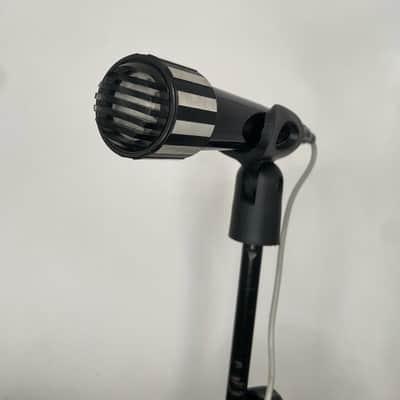

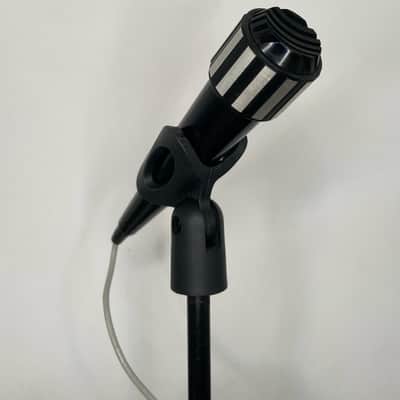
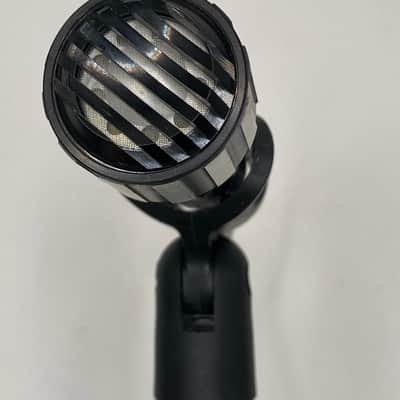
REFURBISHED - RFT DM 2112 M - OMNI DYNAMIC - 1970s - XLR


Introduced around 1970, the DM 2112 was a compact dynamic microphone manufactured by VEB Fernmeldewerk Leipzig in the former DDR.
It was not conceived as an exotic studio microphone. Period documentation describes it as a microphone intended primarily for the transistorized tape recorders of its time. The DM 2112 M was the medium-impedance version, using a small internal transformer to provide approximately 1 kΩ output impedance. A lower-impedance companion version was also produced.
OPTICAL CONDITION
Very good vintage condition with normal minor signs of age and use.
TECHNICAL CONDITION
refurbished, tested and fully functional
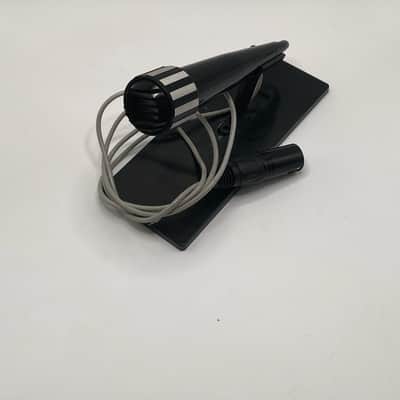
The microphone has been converted to a modern balanced XLR connection and carefully tested after conversion. Clean, stable output and correct omnidirectional behaviour.
INCLUDED
Original packaging
original Microphone holder
Protective microphone bag
SIMPLE, STURDY, EAST GERMAN
The construction is wonderfully straightforward. with a small known German trick
A narrow body surrounds a conventional dynamic moving-coil system, with very little externally to complicate the design. At approximately 165 mm long and only 130 grams, it is compact and lightweight, yet feels surprisingly sturdy in the hand.
supplied in plastic or polystyrene packaging, and with a small table stand, that connects to the plastic top of the box.
THE OPEN OMNI
The omnidirectional construction defines this microphone much more strongly than we remembered from our previous example.
There is essentially no dramatic proximity-effect transformation when moving toward the microphone. Instead, it remains open to the surrounding acoustic environment and captures considerably more of the room than a typical directional handheld dynamic.
In our listening tests, that behaviour was immediately obvious.
Turn away from it and the microphone continues listening.
Move around it and the sound remains remarkably present.
Put it into a lively room and that room becomes part of the recording.
SOUND
The sound is distinctly vintage.
The lower range is restrained rather than large, while the middle and upper-middle frequencies carry much of the microphone's character. There is a slightly nasal, somewhat roomy quality through the presence region, but also surprisingly useful high-frequency extension for such a modest early-1970s dynamic microphone.
Period specifications give 50 Hz–15 kHz, which corresponds well with what we hear: it is certainly not a full-range modern condenser, but neither does it sound severely enclosed or bandwidth-limited.
At moments, its openness can almost suggest the spatial behaviour of a condenser — not because the transducer technology is similar, but because the omni pattern allows so much surrounding sound into the recording.
That is both its character and its limitation.
In reflective spaces it can become roomy very quickly, and on amplified stages its broad pickup naturally offers considerably less feedback rejection than a cardioid or hypercardioid microphone.
But in the right environment, that openness is exactly what makes it interesting.
A MICROPHONE OF EVERYDAY DDR RECORDING
The DM 2112 belongs to a very different part of microphone history than the great broadcast and studio microphones of the DDR.
It was an accessible microphone for ordinary recording equipment.
A 1970 technical report describes the DM 2112 as the medium-impedance version intended for typical transistorized tape recorders, with an internal miniature transformer providing the appropriate electrical matching. Its original selling price was 54 Mark.
That modest origin is part of its charm today.
It is not pretending to be an SM 69, a CMV 563 or an MD 441.
It is a small piece of everyday East German audio engineering that still functions perfectly well more than half a century later.
THIS EXAMPLE
This DM 2112 has been brought into a much more practical modern configuration.
The original microphone system remains intact, while the connection has been converted to balanced XLR for straightforward use with contemporary recording equipment.
After conversion we tested it carefully.
The result is exactly what this model should be: strongly omnidirectional, mid-focused, slightly nasal, relatively restrained in the bass, but with considerably more upper-frequency extension than its humble appearance might suggest.
It is compact, durable, unusual — and genuinely usable.
THE OPEN OMNI
The DM 2112 is not valuable because it was an elite studio microphone.
It wasn't.
Its appeal lies somewhere more interesting: it represents the ordinary recording technology that people actually lived with.
And today, its extremely open omnidirectional pickup and unmistakably vintage tonal balance give it a character that is increasingly uncommon in modern handheld dynamics.
A simple microphone, a very particular sound, and a small surviving piece of everyday DDR audio history.
Reverb-Käuferschutz
Reverb hilft dir weiter, wenn dein Artikel verloren geht, beschädigt ist oder nicht der Beschreibung entspricht. Melde alle Probleme einfach innerhalb von 7 Tagen und wir verhelfen dir zu einer vollständigen Rückerstattung.Erfahre mehr über den Reverb-Käuferschutz.
| Inseriert | vor 4 Tagen |
|---|---|
| Zustand | Hervorragend (Gebraucht) Hervorragende Artikel sind fast ohne Gebrauchsspuren oder optische Fehler, aber wurden gespielt und vorsichtig benutzt.Weitere Informationen |
| Marke | |
| Modell |
|
| Kategorien | |
| Jahr |
|
| Hergestellt in |
|
Möglicherweise sind hier Informationen zur Produktsicherheit verfügbar.

Reverb-Schutz
Einfache Rücksendungen, sichere Transaktionen, Support von Experten
Weitere Informationen