As rock 'n' roll ushered in a new era of pop music and pop culture across the globe. The US market saw electric guitar sales soar with an increase of 400% between 1958-1965. In 1967 Billboard even named the electric guitar, “the golden-growth instrument” of their time.
But across the pond in the UK, despite the bulk of the world’s defining guitar amplification being designed and built here, we took a… less predictable route in guitar manufacture. The global import structure of the modern world didn’t exist, and the distance between the US and UK meant an American built Fender Stratocaster was a much harder thing to come by.
Undeterred, the British strapped on their thinking caps, and set about building some of the weirdest, coolest and most surprising electric guitars the world had ever seen.
Vox Organ Guitar
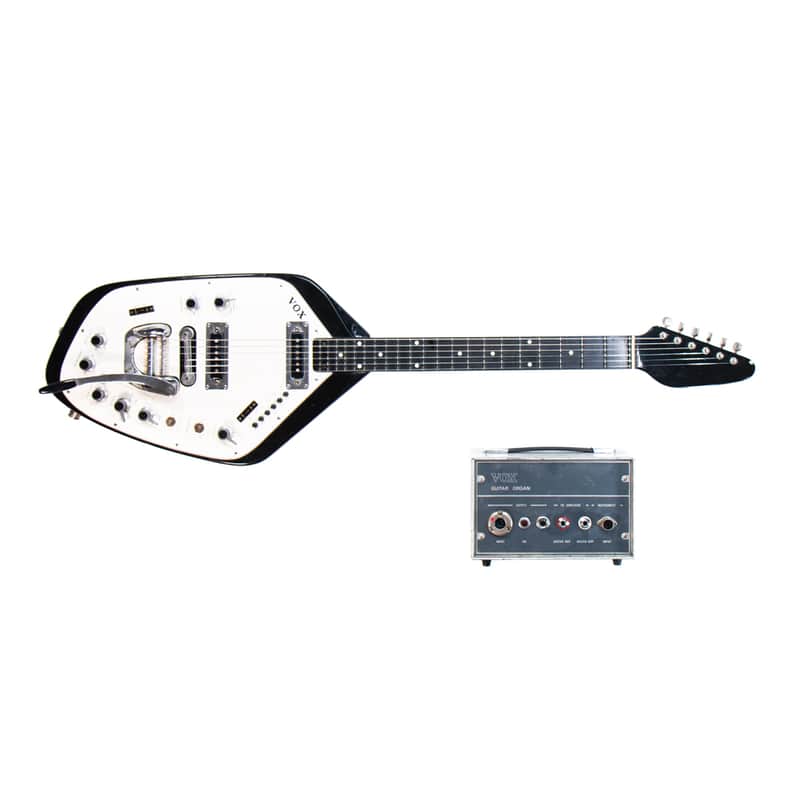
Let’s kick things off with undoubtedly one of the most outlandish guitars probably to ever be built, even by today’s standards, the Vox V251 Guitar Organ. This guitar came in the form of the already unconventional Phantom guitar body shape, but with an awful lot more to offer.
Designed in the early 60’s by Vox lead engineer Dick Denney, the Guitar Organ utilised the solid state organ circuitry of the Vox Continental organ. Through a very complex means it allowed the instrument to be played as a guitar or an organ, both in combination or individually.
In order for the ‘organ’ element of the instrument to interpret guitar notes and chords, the Guitar Organ had 6 individual organ tone generator circuits built into the guitar body, one for each string.
The frets each had a further 6 contact points beneath each string, so that fretting the guitar would complete the circuit and through a complex method of calculating the ohms separating the organ tone generator input signal from ground, would create the appropriate note.
The guitar itself came with an external power block to provide enough juice for this rather wonderful instrument to produce sound. Needless to say, it was built in very small quantities and is considered one of the rarest vintage Vox guitars of all!
Burns/Baldwin Vibraslim
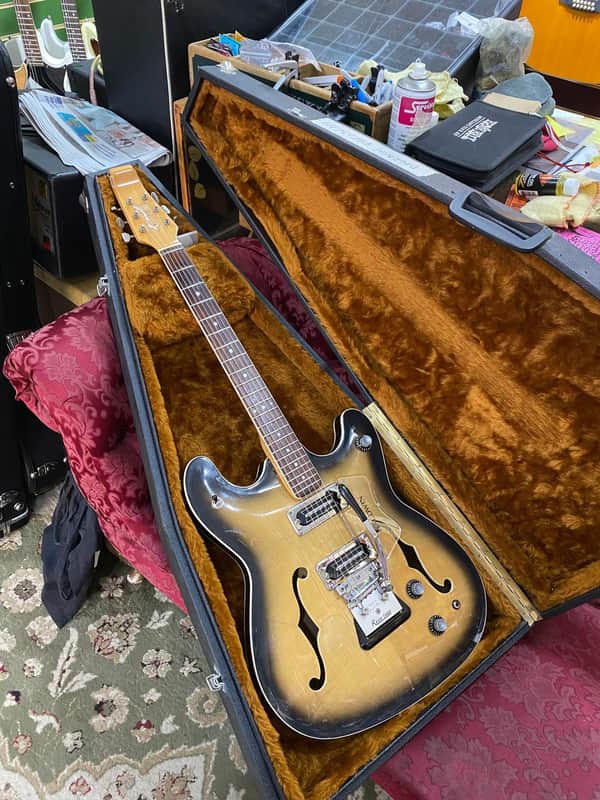
Dialling things back for a moment, let’s take a look at the Burns/Baldwin Vibraslim. In many ways this was the British ES-335; a pressed laminated-wood thinline archtop with a pair of relatively high output Ultra-Sonic pickups.
Introduced into the Burns catalogue in 1964, the Vibraslim lived through a company ownership change when Burns sold to American Piano Manufacturer, Baldwin Pianos in 1965. Whilst the instrument had some changes as production moved states-side, it’s the early Burns and rebadged UK built Baldwin models that have some of the most unique features.
Most notable is the lack of any control knobs cut into the body of the instrument. Instead Burns favoured a selection of “fingertip rotary controls” fitted beneath the scratchplate for easy control without the risk of any settings being knocked by an errant strum.
Burns GB 65
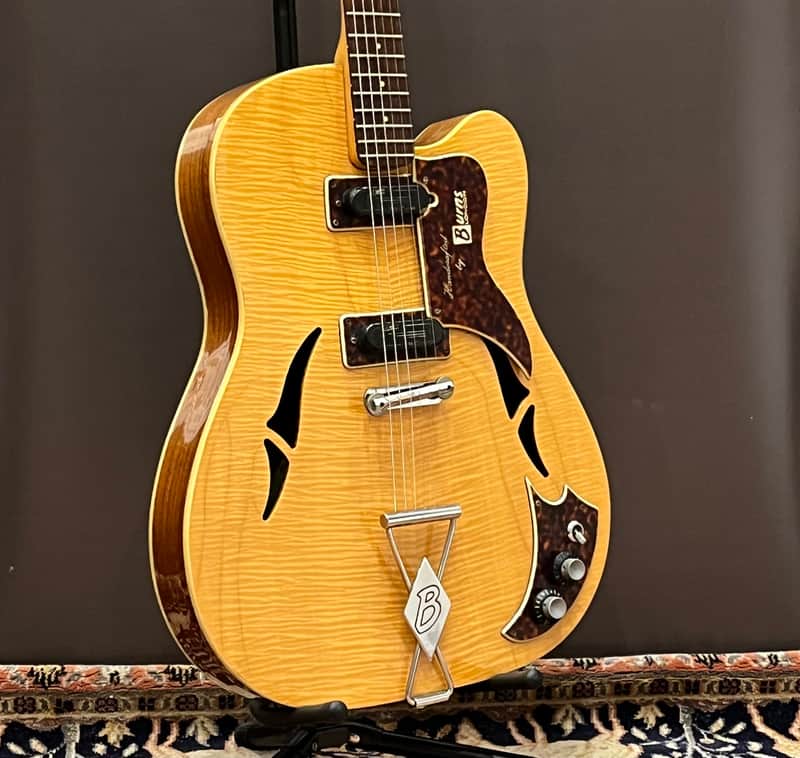
Staying with the great British leviathan of the 60’s, Burns/Baldwin, the GB65 is a gloriously rare example of British luthiery of the time. A flat-topped hollow body with two of Burns’ extremely high output Rez-O-Matic pickups and an unusually long 25 1/2" scale neck.
This particularly lovely instrument was very limited in production, and was built for a little over a year between 1965 and 66. 1965 was, of course, the year that Baldwin bought Burns and the GB65 was one of the first instruments to face the chop. Only a couple of production batches were ever completed, and models can be found with either the Burns or Baldwin logo, the only physical difference being the engraving on the pickguard.
Shergold Double Neck
Flash forward to the golden age of Shergold guitars in the UK; the 1970’s. Shergold were wonderfully unconventional looking for the time. Fender and Gibson had established themselves across the globe as an industry standard for body shapes, scale lengths, and control functions. At the same time, Japan was starting on what would be an incredible 30 year stint of creating some of the best ‘law-suit era’ clone guitars ever built, further embedding Fender and Gibson as the definitive electric guitars.
Shergold, however, trod a different path. Stout, functional looking, heavy, and visually an ‘acquired’ taste, Shergold’s flagship Masquerader guitar and Marathon bass were nonetheless making waves in popular music appearing in the hands of Genesis’ Mike Rutherford, and Joy Division’s Bernard Sumner and Peter Hook.
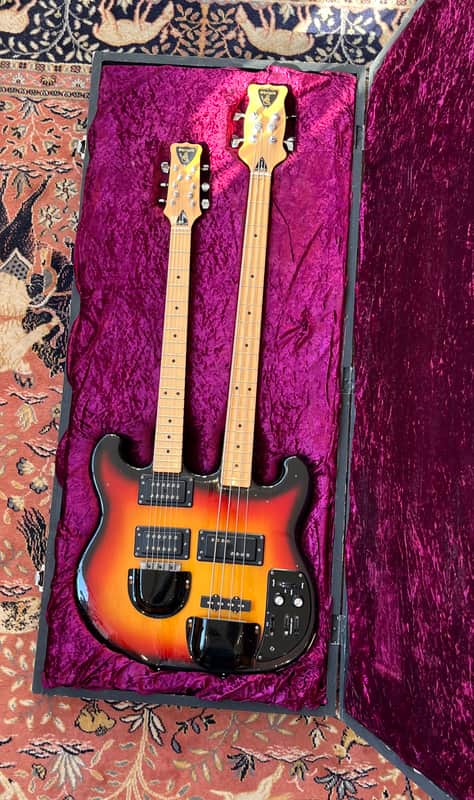
And, it’s in the hands of Mike Rutherford that first appeared the Shergold Custom Double. Introduced in 1977 and made in quantity from 1978 to satisfy the demand created by the prominent use by Genesis’ guitarist, this double neck boat oar of a guitar is the fusion of the Masquerader and Marathon. The instrument even includes dual outputs, so it can function in mono or with the guitar and bass sent to different amplifiers.
Vox Mando Guitar
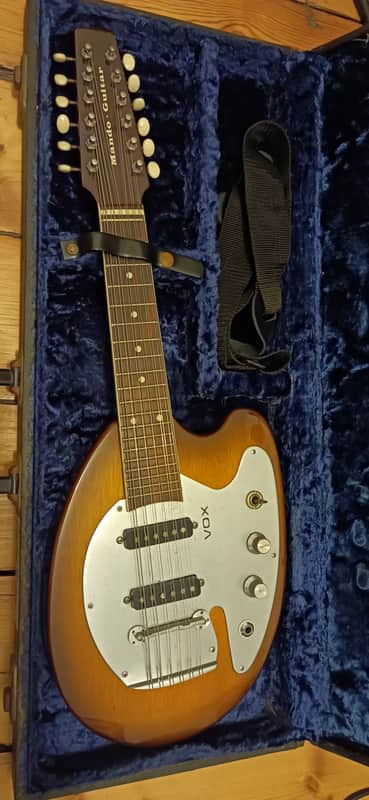
Completing this Vox sandwich of wonderful weirdness, there is nothing that summarises the wild, off-piste creativity of British luthiers in the 1960’s more than the Vox Mando Guitar, sometimes known as the Octave 12.
A 12-string, super short-scale (15.5 inches) instrument with a mini, mandolin-like body, the Vox Mando Guitar was produced properly from 1966 in both the UK and Italian EKO factories for Vox. It appeared, most notably, in the hands of both The Beatles’ George Harrison and The Beach Boys’ Brian Jones, and can be heard on The Beatles version of "Words of Love" and is even credited on The Beach Boys’ "Mother's Little Helper".
“Brian Jones - Vox Mando-Guitar, Tambura, Distorted Electric Guitar.”
The Mando Guitar is tuned one octave higher than a standard guitar, giving it the tonal range of a mandolin. Enabling a guitarist to emulate the sound of a mandolin, but with a fuller 12 string range. Tonally, the instrument is similar to a 12th fret capo’d 12-string guitar, however, unlike a standard 12-string guitar, the strings are tuned in unison rather than in octaves.