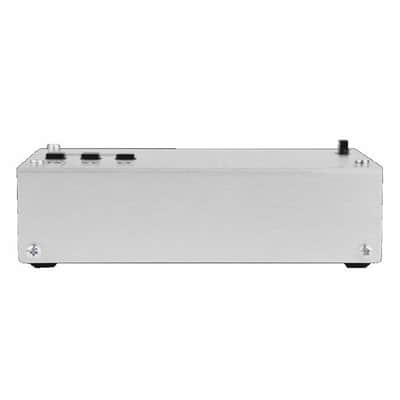
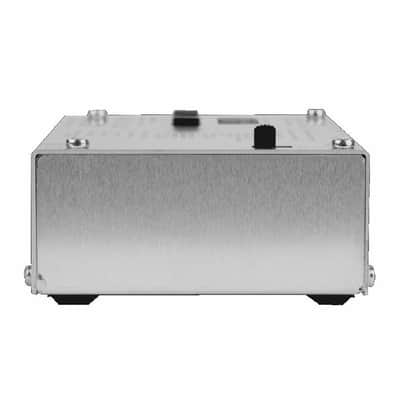
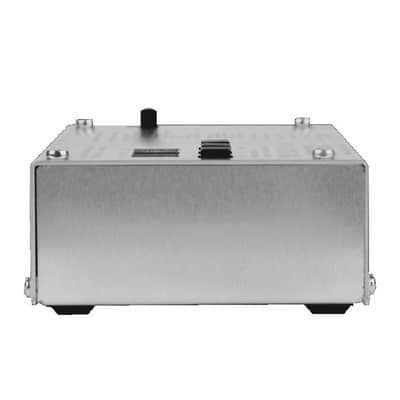
Kenton USB Solo mk2 Single Channel USB MIDI To CV Converter
Price€239.24
+ Shipping
This listing has ended
See similar gear from other Reverb sellers
Listed:a month ago
Views:9
Watchers:0
London, United Kingdom
Our users rate Reverb
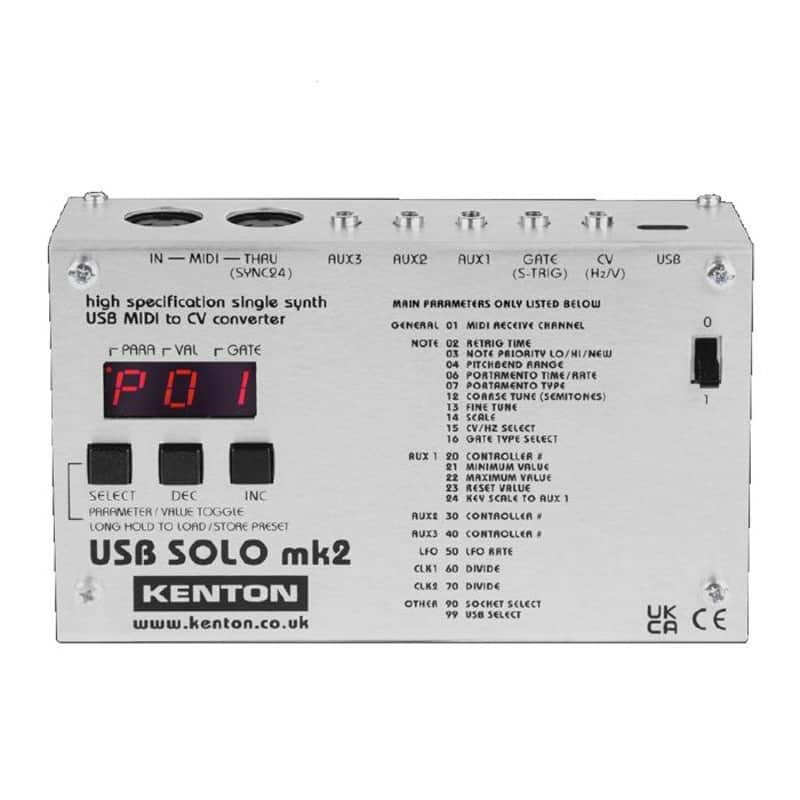
With both USB and 5 pin DIN MIDI ports, the USB Solo mk2 is a highly configurable, high-specification MIDI to CV converter designed to control all types of mono-synth from your DAW, with super-fast response times and Kenton's famous build quality.
In addition to MIDI to CV conversion, the USB Solo is also a USB MIDI Interface, allowing you to easily attach your 5 pin DIN MIDI devices to your DAW. It has all the CV conversion features of the Pro Solo mk3, including 3 continuously variable auxiliary outputs, a built-in LFO and ADSR envelope generator, the ability to smooth out steppy MIDI CCs and more.
The USB Solo mk2 is the ideal converter for anyone looking to incorporate an analogue synthesizer, vintage or otherwise, into their MIDI setup. For maximum compatibility, the CV output can operate not only with the regular 1 V/Oct and Hz/Volt standards, but also at any scaling from 0.92 V/Oct right up to 1.62 V/Oct to accommodate almost any synth including Bulchla and EML. Similarly, the tuning can be coarse and fine-tuned, up to +/- 2 octaves. It has a wide pitchbend range too. The Gate output can work at several different voltage levels, and can also be set to deliver S-trig.
The three continuously variable auxiliary outputs are presented on 3.5mm jack sockets, and can be configured to respond to MIDI CCs, velocity, aftertouch, clock and more. In addition to this, the MIDI Thru port can be switched to output Sync24, so your vintage Roland equipment can join in as well.
All configuration can be done via the front panel or our new USB Solo mk2 Configuration Manager app.
A USB-A to USB-C lead is supplied with the unit, all other leads are sold separately.
Dual MIDI ports: USB Solo mk2 can receive and transmit data simultaneously over USB and 5 pin DIN. It has 2 modes of operation - in standard mode it is a MIDI to CV converter; in interface mode it acts as a USB MIDI Interface as well as a MIDI to CV converter:
Standard Mode - MIDI data received over USB and 5 pin DIN is converted to CV. MIDI data received over the the 5 pin MIDI IN is also sent to MIDI Thru.
Interface Mode - As well as converting to CV as in Standard mode, MIDI data received over USB is sent to the 5 pin DIN MIDI Thru, and data received over the 5 pin DIN MIDI IN is sent to USB.
High specification MIDI to CV conversion: The CV outputs are driven by high specification 16 bit D/A converter for rock-steady pitches and smooth modulation. In addition to CV and Gate, there are 3 Auxiliary outputs that can be mapped to MIDI controllers so you can control filter cutoffs and other functions on your synth that have CV control.
Works with almost any CV synth: Our flexible CV/Gate configuration allows us to support just about any synth that offers CV control that you can think of:
- CV - 1 to 1.5 V/Oct or Hz/V
- Gate - 5, 10 or 15 V Gate, or S-trig with no pullup, or 5, 10 or 15 V pullup
- DIN Sync / Sync 24 output
- The MIDI Thru can be re-assigned as a DIN Sync / Sync 24 output running at 24 (for Roland drum machines, MC-202) or 48 ppqn (for Linn, Oberheim and some Korg drum machines), or the MIDI clock can be divided down to 1-12 ppqn.
Pitch Generation: Pitch is generated from the MIDI notes received on a specified MIDI channel.
Note priority can be set should multiple notes be received:
New note priority:
-Low note priority (lowest note currently pressed)
-High note priority (highest note currently pressed)
- Pitchbend can be set at up to +-48 semitones
The LFO applied to the pitch can be controlled by:
- MIDI CCs 0 to 119
- Aftertouch
- Velocity
- Pitch Bend
- Portamento can be set as follows:
- Always On
- Always Off
- Automatic
- controlled by MIDI CC 0-119
- and can be applied at a fixed rate (that you can specify) or fixed time.
Auxiliary outputs: If your synthesizer has inputs for additional control voltages, such as for filter cut-off or VCA volume, these can also be controlled using the USB Solo's three Auxiliary Outputs. Each Aux output has its own Controller, as well as a couple of special modes. Aux 1 is a special case in that keyboard scale and the LFO can be routed to it in addition to whichever Controller is selected - allowing you to, for instance, send modulation and keyboard scale to your filter cut-off.
Each aux output can be controlled by:
- MIDI CC 0-119
- Aftertouch
- Velocity
- Pitchbend
- Clock Divider 1
- Clock Divider 2
- Clock Start/Stop
- Note Trigger
- Drum Trigger
- ADSR Envelope Generator
- Auto Portamento
- Clock output
Any of the Auxiliary controllers can be used as an analogue clock output using the USB Solo's two clock dividers allowing you to work with many drum machines, arpeggiators and sequencers . The dividers can be set to 24 or 48 ppqn, or the MIDI clock can be divided down to 1-12 ppqn. In addition, the Auxiliary output 1 can be set to a clock start/stop.
Built-in LFO: The USB Solo has its own internal LFO, which can be used to modulate the CV and/or Aux 1 outputs. The amount of LFO that is sent to each of these destinations can be controlled independently, and is assignable to a variety of Controllers. By default, the LFO is routed to the CV output, providing a vibrato effect when the modulation wheel (CC 1) is used.
- LFO Rate 0.1 Hz - 100 Hz (approx): Triangle, sawtooth, pulse (10-50%) and Sample & Hold waveforms
- MIDI clock syncable
- Free-running, or reset on key-on
-- The amount of LFO sent to CV and Auxiliary output 1 can be independently controlled by:
- MIDI CC 0-119
- Aftertouch
- Velocity
- Pitchbend
- Built-in ADSR Envelope Generator
- The USB Solo has its own ADSR envelope generator that can be routed to any of the Auxiliary outputs. The Attack, Delay, Sustain and Decay phases can be controlled by MIDI CCs.
Note Trigger: Produces a trigger pulse when any note on the current MIDI channel is received. This is intended for some synthesizers (mainly vintage ARP models such as the 2600) which require a trigger pulse in addition to a gate signal for their envelope generators.
Drum Trigger: Produces a brief trigger pulse of a user-specifiable length whenever a particular MIDI note is received, suitable for triggering a drum synthesizer. The velocity of the note will control the level of the trigger
Auto Portamento: When used in conjunction with out 5 socket kit for the MC-202 or 5 socket kit for the TB-303, this will automatically turn on the Roland's own portamento when receiving legato notes.
The USB Solo mk2 can be fully configured from the front panel or with the USB Solo Configuration Manager.
What has changed since the USB Solo mkI?: The USB Solo mk2 has been upgraded to match the Pro Solo mk3's specs.
Power Supply: Power 5 V DC via USB-C
Current Draw: 50mA
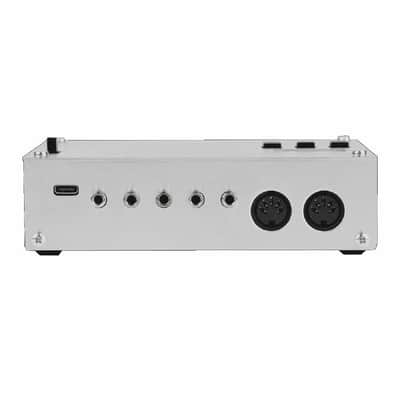
Inputs: USB-C for power and MIDI
5 pin DIN MIDI IN and MIDI Thru (MIDI Thru can be configured as Sync 24)
Outputs: 5x 3.5mm mono jack sockets:
CV: 1 - 1.5 V/Oct, Hz/V (plus fine scaling adjustment of up to +/- 8%)
Gate: Gate (5, 10 or 15 V) or S-trig (no pullup, or 5, 10 or 15 V pullup)
Aux1: approx -2.7 to +10 V
Aux2: approx -2.7 to +10 V
Aux3: approx 0 to +10 V
DACs: CV: 16 bit
Aux 1, 2: 12 bit
Aux 3: 10 bit
Display: 3 character LED panel with 3 buttons for configuration
Dimensions (each unit): 140mm x 87mm x 45mm
Weight (each unit): 210g
Accessories included: User Manual
USB 2.0 Type A to Type C lead (2m)
| Condition | Brand New (New) Brand New items are sold by an authorized dealer or original builder and include all original packaging.Learn more |
|---|---|
| Brand | |
| Model |
|
| Categories |
Product safety information may be available here.