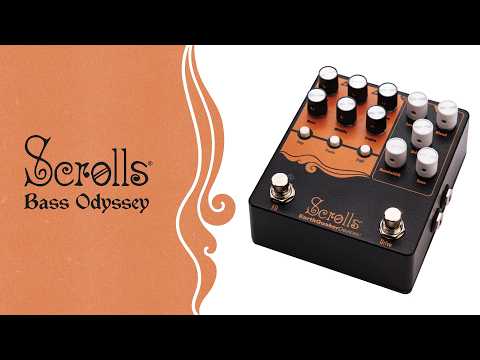
EarthQuaker Devices Scrolls Bass Overdrive & EQ Effects Pedal
This seller has not set a shipping cost for Slovenia. Please contact them to ask about shipping.
Price€481.92
+ Shipping

Only 1 left
Grab it before it's gone
Listed:23 days ago
Views:28
Watchers:2
London, United Kingdom

14-Day Return Policy
Enjoy peace of mind with your new gear
Our users rate Reverb
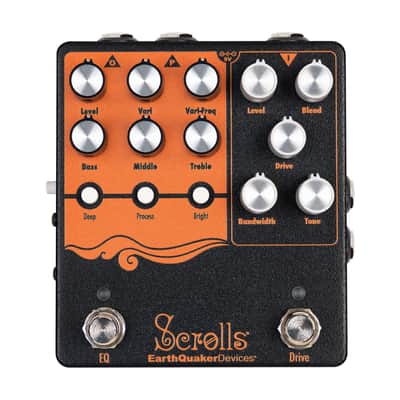
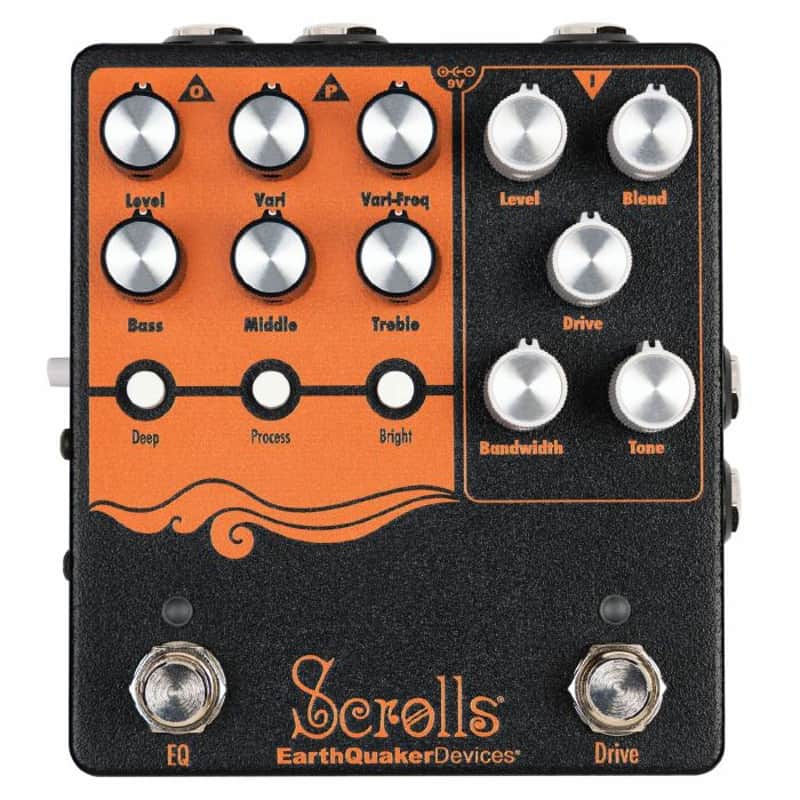
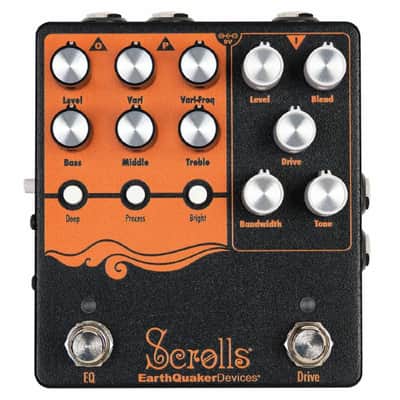
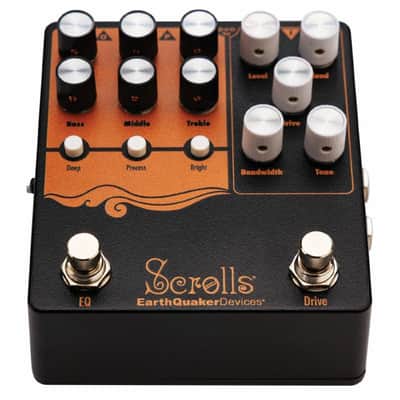
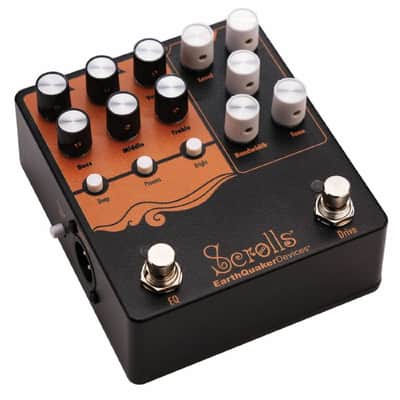
Scrolls Bass Odyssey is a sonic pilgrimage through the entire universe of electric bass tone. From Motown to Metal and everywhere between and beyond. With a tube amp-like drive channel, an active EQ channel with three push-button switches for one-click tone sculpting, buffered parallel out, onboard effects loop, and balanced XLR out featuring just a splash of analog filtering to emulate a speaker cabinet, Scrolls is a powerful, modern tool that's compact and versatile enough to be the only thing you need to play a session or show other than a bass.
The left side of Scrolls features a full suite of active EQ controls including audiophile-quality Bass, Middle, and Treble controls. The secret weapon of Scrolls' EQ section is the Variable Frequency control with the ability to cut/boost frequencies from around 20 Hz to 10 kHz-making it the perfect tool for cutting out the mud and boosting the high-end. Within the EQ section, you'll find three push button switches that serve as potent assets for one-click tone sculpting.
On the right side of Scrolls, you'll find the Drive channel featuring a versatile, tube amp-like distortion. Key amongst the Drive section features are the Blend knob, which enables you to adjust the amount of clean signal present in the overdriven signal, and the position of the Bandwidth knob determines where the clipping is most prevalent-lower frequencies counterclockwise and higher frequencies clockwise. Together, the Blend and Bandwidth knob can be adjusted to ensure the low-end response remains wide, deep, and full when using the Drive section.
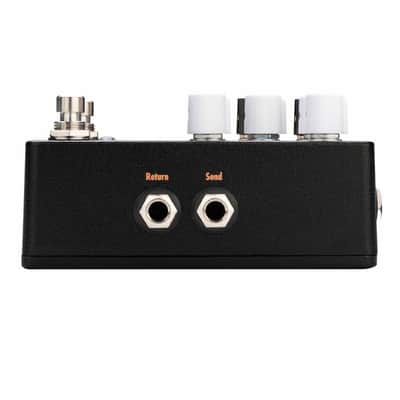
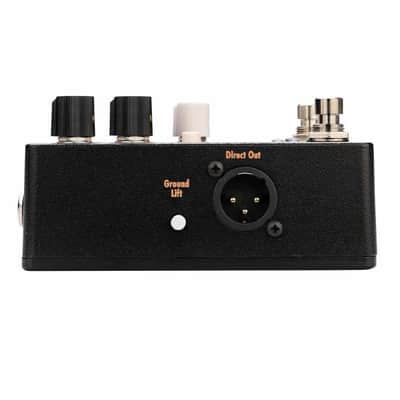
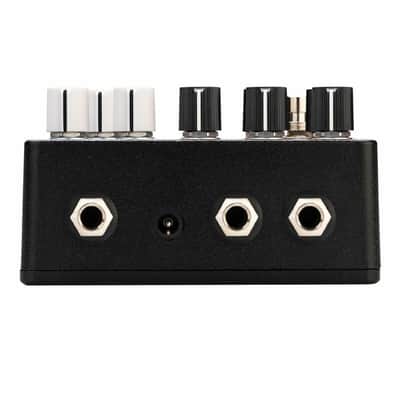
Scrolls features three outputs that all work simultaneously: a buffered parallel out for sending clean signal to an external destination like an amp, tuner, DI, or other effects; a balanced XLR out to run Scrolls directly to front of house or into a recording interface; and a standard 1/4" output. Scrolls also features an effects loop that lives between the Drive and EQ channels. This enables you to place modulation, time-based, or any other effects you'd normally place after dirt pedals (including more dirt pedals) after the Drive channel, while still retaining all the tone-shaping capabilities of the EQ channel.
EQ Controls
Level: Output volume control when the EQ controls are active. Set the knob at noon for unity, turn clockwise to boost the output signal, turn counterclockwise to cut the output signal.
Vari: Boosts or cuts the Variable Frequency control. Position this control at noon for unity (marked with a centre detent in the potentiometer.) Turn clockwise from noon to boost the Vari-Freq, or counterclockwise to cut.
Vari-Freq: Variable frequency control for fine-tuning your tone. Adjustable from approximately 20 Hz to 10 kHz.
Treble: The centre position is flat and marked with a centre detent in the potentiometer. All settings above this point boost the treble and all settings below cut treble.
Bass: The centre position is flat and marked with a centre detent in the potentiometer. All settings above this point boost the bass and all settings below cut bass.
Middle: The centre position is flat and marked with a centre detent in the potentiometer. All settings above this point boost the middle and all settings below cut middle.
Deep: 80 Hz Boost.
Process: Low-mid scoop for a more modern sound.
Bright: 5 kHz Boost
EQ Footswitch: Activates the EQ channel
Drive Controls
Level: Output volume control for the Drive channel.
Blend: Blends between your clean signal with the Drive signal. Turn the knob fully clockwise for maximum crunchiness.
Drive: Controls the intensity of the overdrive.
Bandwidth: Determines where the clipping is most active. Turn the control counterclockwise to activate low-end clipping for a warmer, softer, rounded, and overall more subdued tone. Turn the control clockwise and activate High-end clipping for a present, focused crunch with a tighter low-end.
Tone: Low pass filter enabling you to shape the frequency of the Drive channel. Turn counterclockwise to reduce highs.
Drive Footswitch: Activates the Drive channel
Outputs
Parallel Out: Buffered output carrying your clean signal that is always active. This allows you to route your clean signal to external destinations (amp, DI, separate pedal chain, tuner, etc.)
Direct Out: Balanced XLR out with a subtle amount of analog filtering added to the signal path to simulate the tonal characteristics of a bass speaker cabinet.
Ground Lift: Press for ground lift on the XLR output.
Effects Loop: Situated between the Drive and EQ stages. Hard-wired into the signal path and remains active at all times
Dimensions: 4.75 x 4.50 x 2.25 in. (121 × 114 × 57 mm) with knobs
Current Draw: 70 mA
EQ Input Impedance: 10 MO
EQ Output Impedance: <1 kO
Drive Input Impedance: 500 k?
Drive Output Impedance: 100 O
Parallel Input Impedance: 10 MO
Parallel Output Impedance: 100 O
Direct Output Impedance: 100 O
Switching: Scrolls uses relay-based true bypass switching. Since the switching is relay-based, it requires power to pass a signal. The EQ side uses standard on/off switching, the Drive side uses Flexi-Switchr Technology.
Power: This device takes a standard 9-volt DC power supply with a 2.1 mm negative center barrel. Earthquaker Devices always recommend pedal-specific, transformer-isolated wall-wart power supplies or multiple isolated-output supplies. Pedals will make extra noise if there is ripple or unclean power. Switching-type power supplies, daisy chains and non-pedal specific power supplies do not filter dirty power as well and let through unwanted noise. DO NOT RUN AT HIGHER VOLTAGES!
| Condition | Brand New (New) Brand New items are sold by an authorized dealer or original builder and include all original packaging.Learn more |
|---|---|
| Brand | |
| Model |
|
| Categories | |
| Pedal Format |
|
Product safety information may be available here.