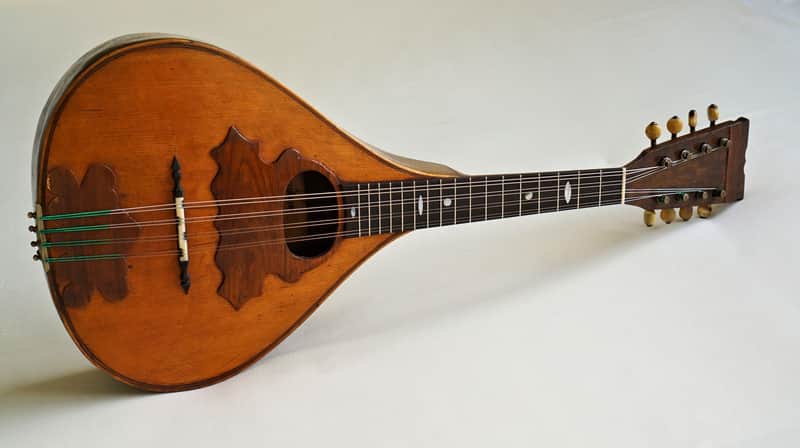
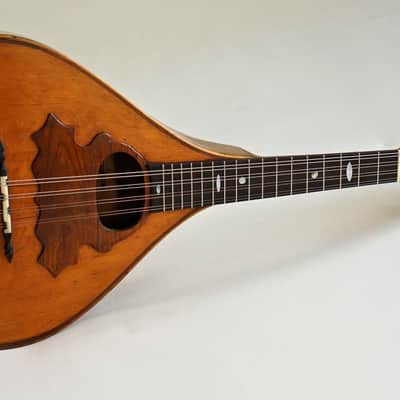
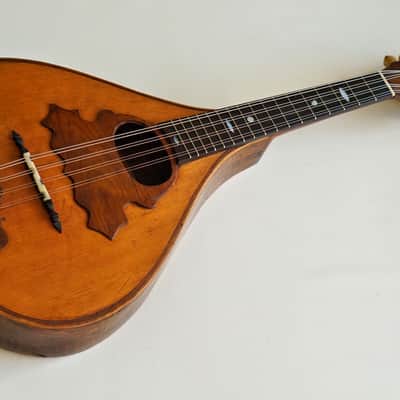
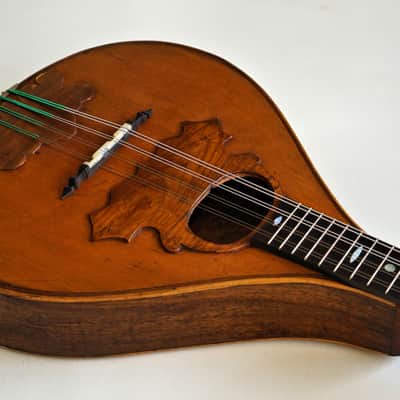
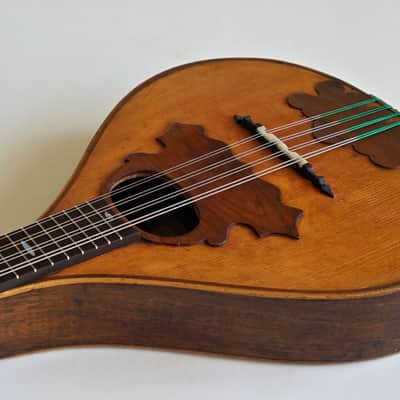
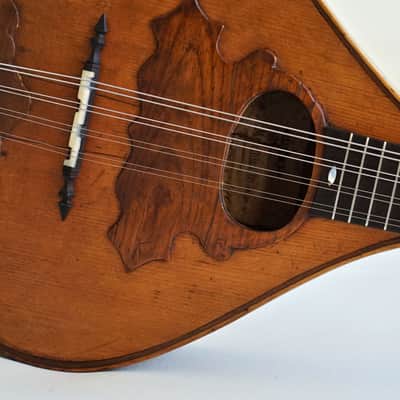
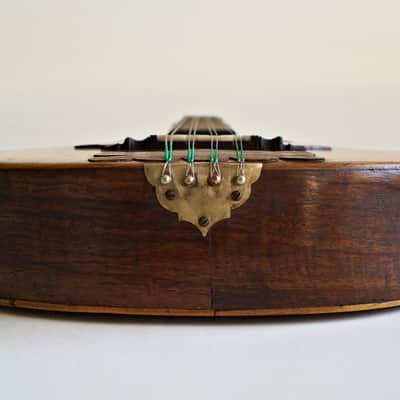
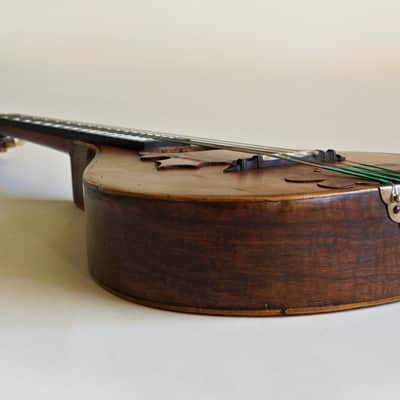
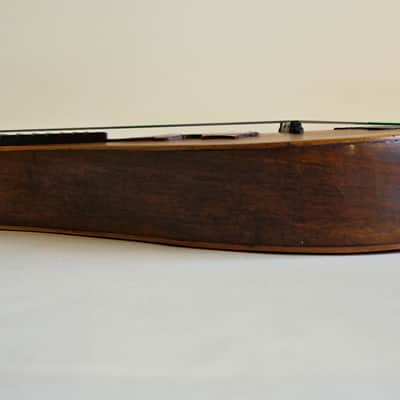
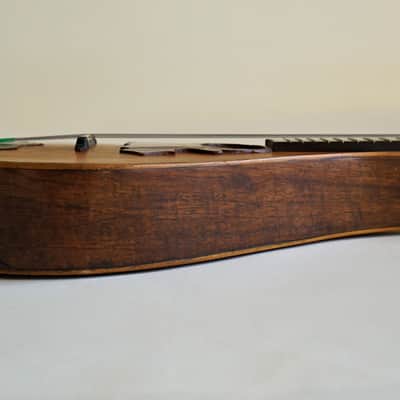
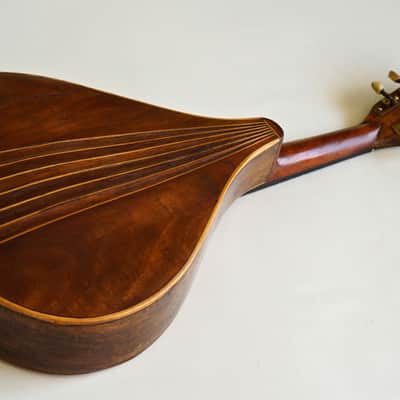
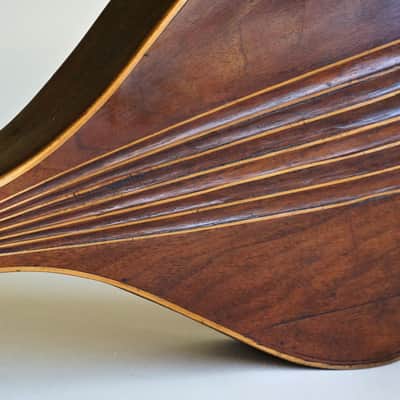
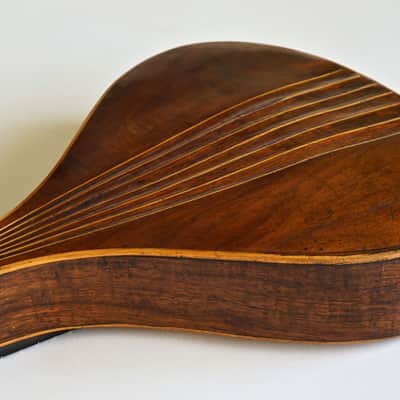
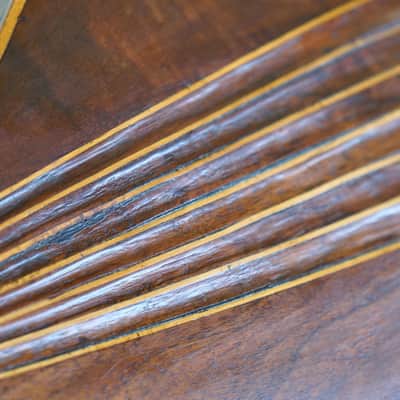
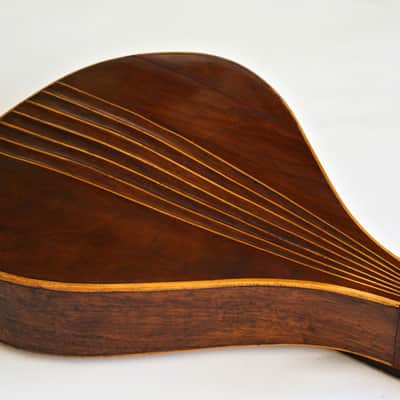
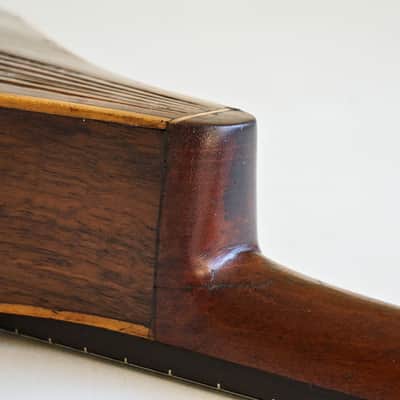
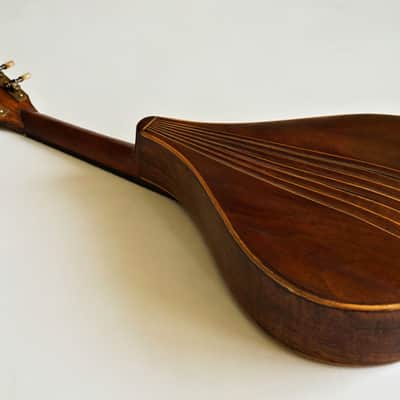
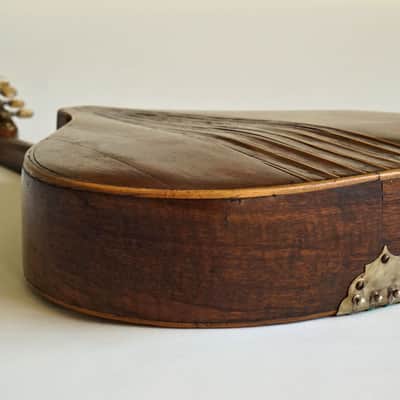
Mandolin by J. Murthwaite Newcastle 1901
Our users rate Reverb
Flat-back mandolin by J. Murthwaite — Newcastle, February 1901
Overview
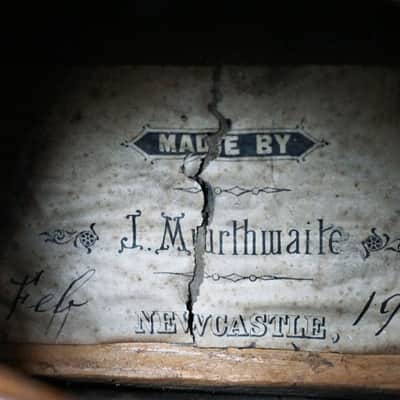
This instrument bears an internal paper label reading:
“Made by J. Murthwaite, Newcastle, Feb. 1901.”
The maker is otherwise undocumented in surviving luthier directories or trade registers, suggesting that this mandolin was produced by a local craftsman or cabinetmaker working on a small scale—possibly as a personal or commissioned experiment rather than as part of an established workshop.
Construction and Materials
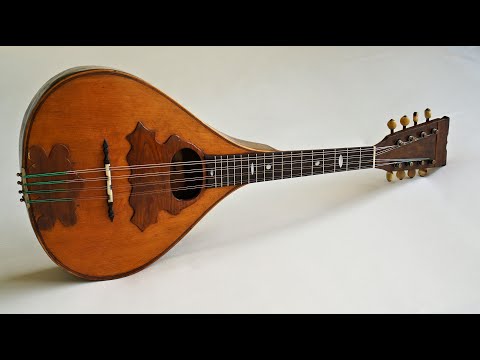
The mandolin follows the general outline of late-Victorian English flat-back types but diverges from the more precise Neapolitan-inspired geometry typical of contemporary professional makers such as J. Winder, La Foley, or J. Dallas. It was originally intended as a 10-string instrument (possibly with triple courses for the treble strings) and was later converted to an 8-string configuration. The scale length does not correspond to standard mandolin or mandola scales, so it is unclear which mandolin-family type the instrument was originally intended to be.
Key observations:
• Scale length: approximately 360 mm (longer than the standard 330 mm mandolin scale)
• Body: two-piece back of likely English walnut or mahogany, showing hand-planed tool marks
• Ribs: assembled freehand rather than on a fixed mold—resulting in slight asymmetry of the outline
• Bracing: simple ladder pattern, linings roughly cut and glued with hot hide glue
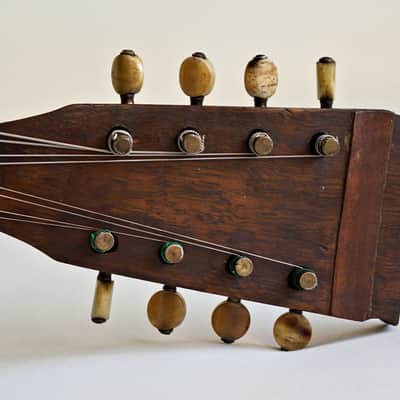
• Headstock: layered construction of several plates over the neck core, a strengthening method common among small British workshops of the period
• Label: printed with decorative border and filled in by hand; ink and typography are consistent with turn-of-the-century English printing
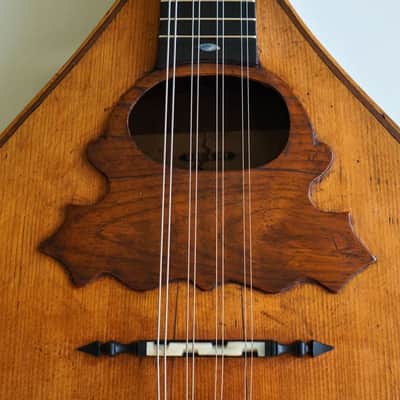
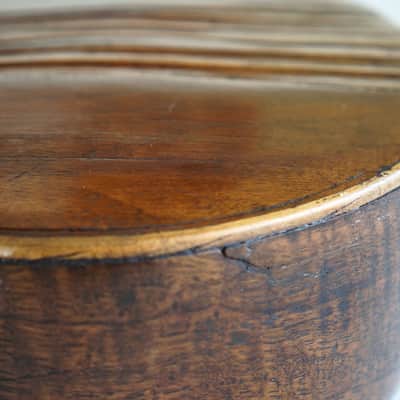
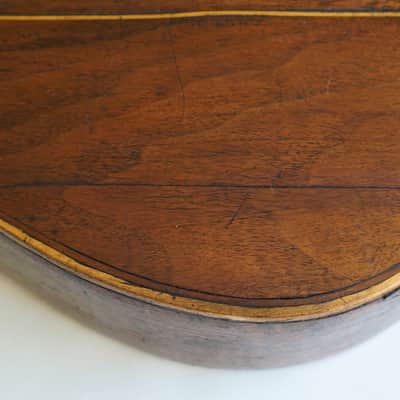
The workmanship is competent but uneven—most notably a corrective insert in the back near the lower bout, added to compensate for misalignment during assembly. Such details clearly indicate hand-built construction without the use of a mold, characteristic of an early or one-off builder.
Condition and Restoration Approach
The instrument shows age wear, with a few shrinkage splits to the front and back, though all are stable. Cleaning was kept minimal, and any repairs were carried out using traditional hide glue and sympathetic conservation methods.
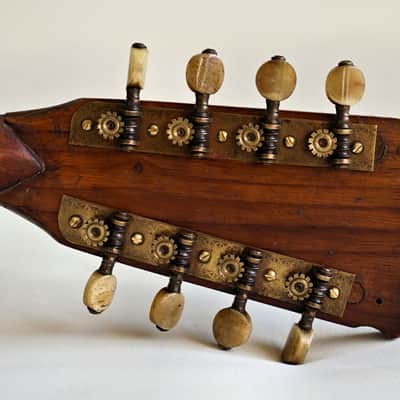
Elements such as the body, finish, label, tailpiece, and bracing are all preserved in situ to retain originality. The tuners are not original but come from a late-19th-century mandolin; they remain in their aged state and are in working condition.
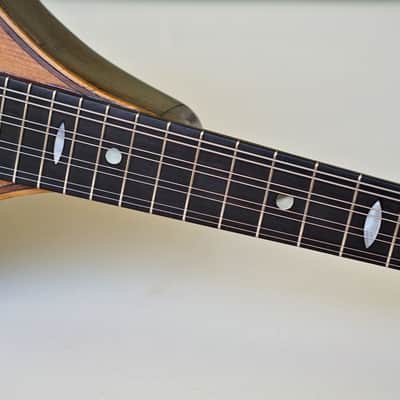
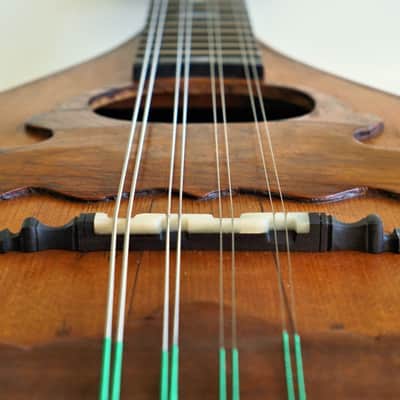
New parts added include an ebony fretboard with the original M.O.P. inlays transferred over, fretted with narrow Japanese silver-nickel wire, plus a new ebony bridge with compensated bone saddle and a new bone nut.
The instrument is currently strung with Optima SET 4105 Special Chrome (.010–.036). It can be tuned as a mandola in CGDA, or a tone higher in DAEB. Due to its age and the structural points noted above, I would not recommend exceeding this tension, and would strongly advise against tuning it to standard mandolin pitch, as this could cause damage to the neck or body.
Historical Context
The turn of the 20th century saw a mandolin boom in Britain, fuelled by local mandolin and banjo orchestras, evening institutes, and music societies. This enthusiasm encouraged a wave of amateur and semi-professional builders—often joiners, pattern-makers, or metalworkers—who produced small numbers of instruments for local use.
J. Murthwaite appears to have been one of these independent craftsmen, working in Newcastle at the height of the movement. His 1901 mandolin embodies the blend of vernacular British craftsmanship and continental influence that defined the period: functional, individual, and regionally distinctive rather than factory-perfect.
Significance
Though not of refined manufacture, the instrument represents an authentic artifact of the Edwardian amateur-luthiery tradition in northern England. Its dated label provides a valuable anchor for the study of locally made mandolins outside the London trade networks. It stands as a rare surviving example of small-workshop instrument making from Newcastle’s early-20th-century craft community.
Tone & Playing Characteristics
This mandolin offers a refined and expressive antique voice:
• Soft, mellow and woody tone
• Quick response with good projection and volume
• Low action: 1.3 mm at the treble side, 1.7 mm at the bass side
For a sound sample, please see the YouTube video (last in photo section)
Although the instrument is fully playable, please bear in mind that it is an antique piece that needs to be handled responsibly; for example, it should not be kept under constant tension for long periods or strung with heavy-gauge string sets.
📏 Measurements
• Total length: 62 cm
• Body width: 28 cm
• Body length: 33 cm
• Body depth: 5.3 cm at neck heel, rising to 6.8 cm at tailpiece
• Scale length (nut to 12th fret): 180 mm (≈360 mm total)
• Neck width: 30.8 mm at nut, 38 mm at body joint
I’m happy to ship the mandolin internationally. However, I’m unable to provide advice on any import taxes or customs charges you may be responsible for. The current postage cost is an estimate and may vary depending on the destination. Please contact me for an accurate shipping quote.
| Listed | 13 days ago |
|---|---|
| Condition | Fair (Used) Fair condition gear should function but will show noticeable cosmetic damage or other issues.Learn more |
| Brand |
|
| Model |
|
| Finish |
|
| Categories | |
| Year |
|
| Made In |
|
Product safety information may be available here.

