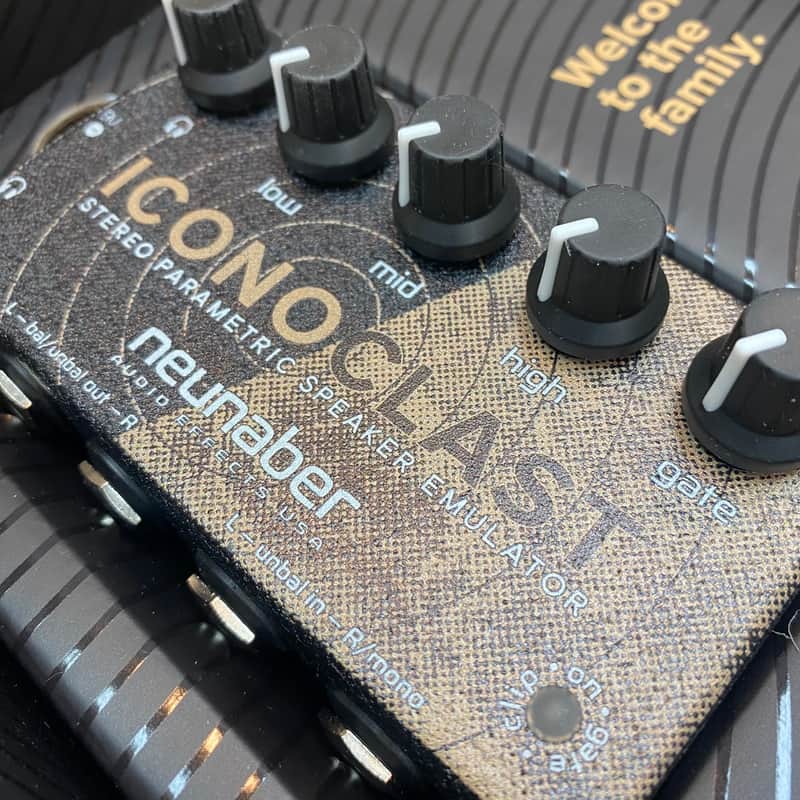
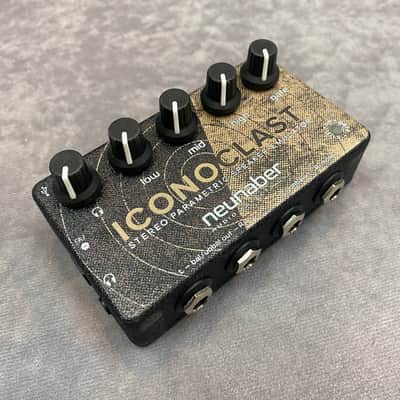
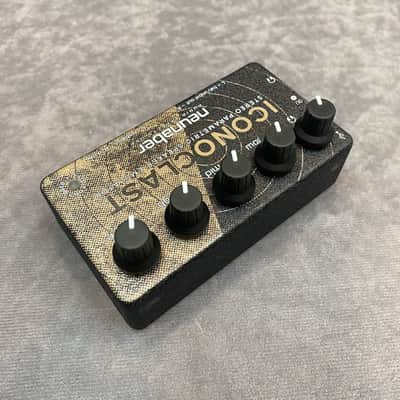
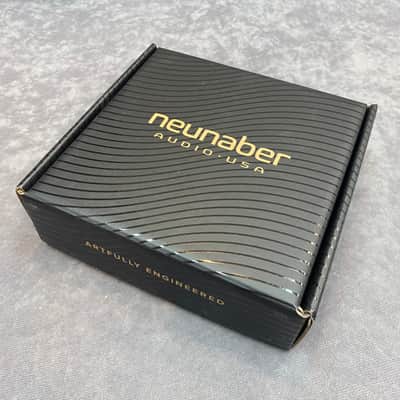
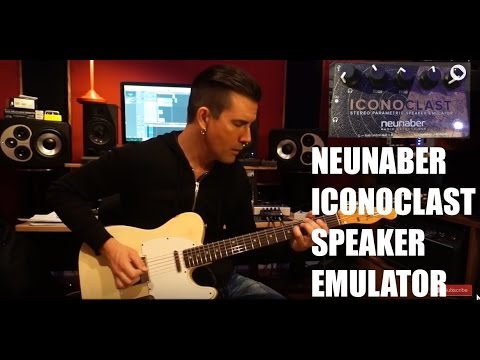
Neunaber Audio Iconoclast Speaker Emulator 2010s - Black/Gold
Our users rate Reverb
Neunaber Audio Iconoclast Speaker Emulator 2010s - Black/Gold
Loudspeakers used for guitar amplification do more than simply make the signal louder. They dramatically shape the signal—significantly attenuating very low and very high frequencies, while less dramatically affecting other frequencies. Furthermore, the loudspeaker can interact with the amplifier that drives it, resulting in a dynamic response.
Unfortunately, guitar loudspeakers can be highly directional and dependent on positioning. Where the listener stands (or places a mic) in front of a guitar cabinet can drastically affect the sound. Placing the cabinet too close to a wall, tilting or raising it off the floor will also have a dramatic effect.
The loudspeakers themselves—especially those used for guitar amplification—can have serious deficiencies in their response. These speakers are chosen primarily for their ability to shape the sound at the extents of the response curve, as well as for high sound output (sensitivity). Response smoothness is sacrificed, which is generally required for high-fidelity sound.
IRs (impulse responses) of guitar speakers are digital samples of the loudspeaker’s response and are therefore susceptible to these same deficiencies. To make matters worse, they are usually sampled at specific point-positions rather than averaged over an area or volume, which results in an inaccurate representation of the apparent response.
To mitigate these issues, recording engineers may mic guitar cabinets at multiple locations, use multiple mics, or even multiple cabinets and mics. Likewise, IRs are often combined (averaged) together for the same reason. Iconoclast avoids all this complexity by directly producing a smooth response.
Iconoclast decouples the tone-shaping aspect of the guitar speaker from the process of amplification, allowing you to independently sculpt your tone while avoiding the deficiencies of guitar speakers and IRs. Placed after your pedals and/or preamp, Iconoclast completes your signal chain and provides a direct output to headphones, a recording interface, mixer or powered speakers.
Even in cases where amplification is required, combining an Iconoclast with a compact, high-fidelity powered speaker has several advantages over a traditional guitar amp and speaker:
- Higher sound output per unit weight
- More consistent sound over a wider angle (lower directivity)
- Less dependence on positioning
- Generally more rugged and easier to transport
- Easier to run stereo
Given these factors, we firmly believe that running direct with Iconoclast yields a superior experience to that of a dedicated guitar amp.
Controls
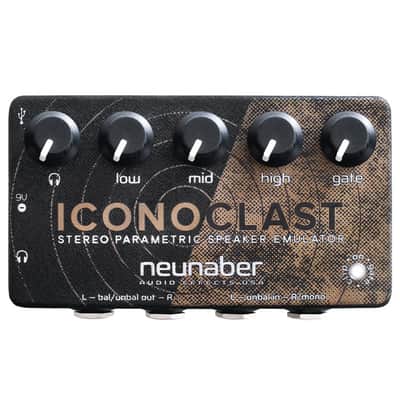
HEADPHONE LEVEL
The Headphone Level knob controls the level of the Headphone Output. It does not affect the level of the L/R outputs. To protect your hearing, start with this knob turned down and adjust upward only if needed. Turn this knob down when connecting/disconnecting cables or power to the device.
LOW, MID & HIGH CONTROLS
These controls are unique in that they do not operate like typical tone controls. Their functions were chosen to be meaningful in different ways—
- For those who want clear, simple functionality: the Low knob affects the lows, the Mid knob affects the mids, and the High knob affects the highs.
- For those who want controls that correlate with properties of a guitar speaker cabinet–in simplest terms–the Low knob changes the cabinet size and type, the Mid knob changes the amplifier drive type, and the High knob changes the speaker type.
Using only these three controls, a wide variety of amplifier+speaker cabinet tones can be achieved.
LOW
The Low Knob affects the character of the low frequencies, which is similar to changing the virtual size and type of speaker cabinet. By default, this knob transitions from a single-12” open-back cabinet (full counter-clockwise) to a 4-by-12” sealed-back cabinet (full clockwise).
MID
The Mid knob is essentially an amplifier damping-factor control and behaves as a broad midrange cut when turned counter-clockwise.
Iconoclast emulates the interaction between the virtual drive amplifier and the loudspeaker, which depends largely on the damping factor of the amplifier. The lower the damping factor, the greater the effect of the loudspeaker’s impedance on its frequency response. The impedance curve of most guitar speakers is (approximately) a broad midrange cut; therefore, an amplifier with a low damping factor will impose this broad midrange cut on the overall response.
HIGH
The High knob affects the character of the high frequencies by changing the drop off frequency of a steep filter. Turning the knob clockwise lets through more high frequencies.
Guitar speakers behave as a sharp low-pass filter, with different loudspeakers having different frequencies at which they sharply drop off. However, many guitar speakers retain a small amount of signal “fizz” beyond their cutoff frequency. Iconoclast reproduces both the sharp drop off and fizz of a guitar speaker and does so using adjustable filters. The drop off frequency is directly adjustable with the High knob.
NOISE GATE
The Gate knob adjusts the threshold of a studio-quality noise gate. The gate’s threshold is the level at which the gate closes (attenuates the signal). The LED turns blue to indicate that the gate has closed. Turning the knob fully counter-clockwise disables the gate.
Noise from various sources in the signal chain can accumulate to an unsatisfactory level, even if the noise from any one particular device is inaudible. A noise gate at the end of the signal chain is often invaluable, which is why we chose to incorporate one in Iconoclast.
Specifications
I/O
Inputs:Unbalanced: mono (R only), stereo (L/R), stereo TRS (L only)
Nominal input level:-10 dBV, instrument/consumer line level
Absolute max input: level6 dBV
Input impedance: 1 MΩ (mono), 2 MΩ (stereo)
Outputs: Impedance-balanced: mono (L or R), stereo (L/R)
Output impedance: 100 Ω
Electrical
Insertion gain: Approximately unity, depending on settings
Signal-to-noise ratio: 106 dB typical, A-weighted, gate closed
Total harmonic distortion: 0.01% typical
Crosstalk: -87 dB, A-weighted
Sample rate: 96 kHz
Minimum latency: 0.315 ms
Power
Power input: 9-12 V DC
Current w/o phones: 60 mA typical
Current w/ 32 Ω phones: 100 mA @ max phones level
Current w/ 16 Ω phones: 120 mA @ max phones level
Connector: center-negative, 5.5 mm OD x 2.1 mm ID
Recommended adapter: 9 V DC, 100 mA or greater, (Boss-compatible) pedal power supply
Physical
Dimensions: 4.6” W, 2.8” L, 1.9” H / 116 mm W, 68 mm L, 47 mm H
Weight:8.0 oz / 227 g
This item is sold As-Described
This item is sold As-Described and cannot be returned unless it arrives in a condition different from how it was described or photographed. Items must be returned in original, as-shipped condition with all original packaging.Learn More.
| Condition | Brand New (New) Brand New items are sold by an authorized dealer or original builder and include all original packaging.Learn more |
|---|---|
| Brand | |
| Model |
|
| Finish |
|
| Categories | |
| Year |
|
| Made In |
|
| Number of Inputs |
|
| Electronics |
|
| Reverb |
|
| Pedal Format |
|
| Number of Channels |
|
Product safety information may be available here.

