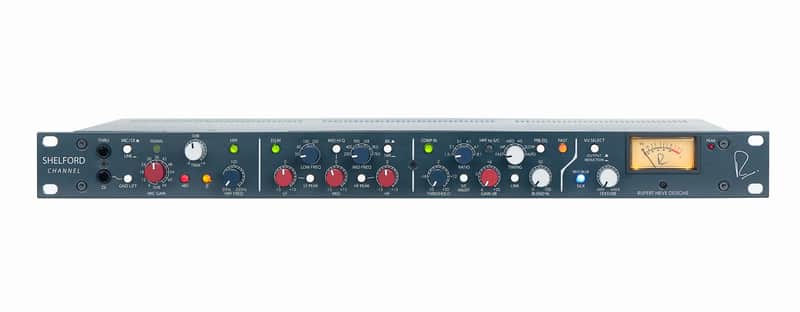
Rupert Neve Designs Shelford Channel

Only 1 left
Grab it before it's gone


Our users rate Reverb
Open Box Demo.
Please ask for more photos/information if you're concerned about buying an open box item.
Over fifty years in the making, the Shelford Channel is the definitive evolution of the original technologies in Rupert's classic console modules like the 1073, 1064, 1081 & 2254, thoughtfully advanced and refined for the 21st century studio. The Shelford Channel is built around Rupert Neve's first new transformer-gain, class-A microphone preamplifier in over 40 years, the "best-of-the-classics" inductor EQ section from the Shelford 5052, a tone-packed Diode bridge compressor, the analog power of variable Silk saturation, a new dual-tap transformer output stage for maintaining headroom or allowing the full driving of the Channel without clipping standard converters, and twice the operating voltage of vintage designs. With richly-coloured tonal options for making bold statements with your music, and precisely-engineered detented controls for recall, the vintage-inspired Shelford Channel maintains the soul of Rupert's classic designs with new levels of versatility, delivering what can only be described as the combined essence of fifty years of Rupert Neve's designs.
Features:
• Transformer Gain Mic Input
• Direct Input
• Dual Tap Output
• Silk & Texture
• Controls/Switches: MIC/DI/LINE, Gnd Lift, Signal Present LED, Mic Gain, Trim 48V, Phase, HPF, HPF Freq.,
EQ In, LF, Low Freq, LF Prak, Mid Hi Q, Mid, Mid Freq, HF Peak, 8l/16k, HF, Comp In, Threshold, Ratio, SC Insert, Gain, Timing, Pre EQ, Blend, Link, Fast
• VU Meter calibrated to display both average (RMS) output level and compressor gain reduction
Specifications:
• Mic Pre Input Impedance: 2200 Ohms
• Maximum Input: +21.5dBu from 150Hz to 22kHz, +8dBu 20Hz to 22kHz
• Noise (Un-weighted, 22Hz-22kHz, source impedance 150 Ohms balanced): Main Out @ unity gain -100.9dBu
-6dB Out @ unity gain -106.6dBu
+30dB gain (Main Out) -91.37dBu
+66dB Gain (Main Out) -64.1dBu
Equivalent Input Noise -121.37dBu
• Frequency Response: +/-0.25dB from 17Hz to 45kHz
• Direct Input Maximum Input: 8dBu @ 20Hz to 120kHz
• Noise @ Main Output: -100dBu (22Hz to 22kHz)
• Line Input Maximum Input: +30.5dBu 20Hz to 30kHz
• Total Harmonic Distortion and Noise: @ 1kHz, +20dBu output level, no load. Better than 0.002%
@ 20Hz, +20dBu output level, no load. 0.05% Typical (2nd and 3rd harmonic)
• Noise @ Main Output: -101.1dBu (Un-weighted, 22Hz-22kHz, source impedance 40 Ohms balanced, no load.)
• Frequency Response: +/- 0.25dBu from less than 10Hz to 110kHz, -0.32dB @ 120kHz
• Maximum Output Level: +26dBu @ 16Hz to 20kHz
• High Pass Filter: Continuously variable swept frequency from 20Hz to 250Hz. Slope: 12dB/Octave
• EQ Noise: Un-weighted, 22Hz-22kHz, -92dBu
• Signal Present / Overload Indicator: Illuminates GREEN when input stage signal level reaches -20dBu / Illuminates RED when input stage signal level reaches -23dBu
• Diode Bridge Compressor: Noise (BW 22Hz 22kHz):
0 dB Makeup Gain: -84.5 dBu
+20 dB Makeup Gain: -64.2 dBu
Reverb Buyer Protection
Reverb has your back if your item is lost, damaged, or doesn't match its description. Simply report any issues within 7 days and we'll help you get a full refund.Learn more about Reverb Buyer Protection.
| Condition | B-Stock (Used) B-Stock items are sold by an authorized dealer or original builder, but have been opened, blemished, or used in some manner.Learn more |
|---|---|
| Brand | |
| Model |
|
| Finish |
|
| Categories | |
| Year |
|
| Made In |
|
Product safety information may be available here.

