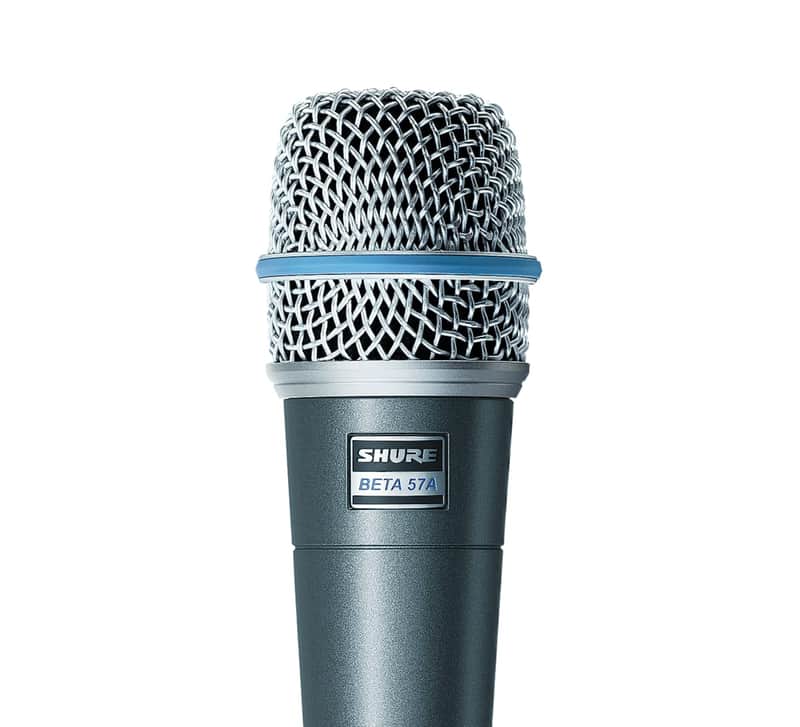
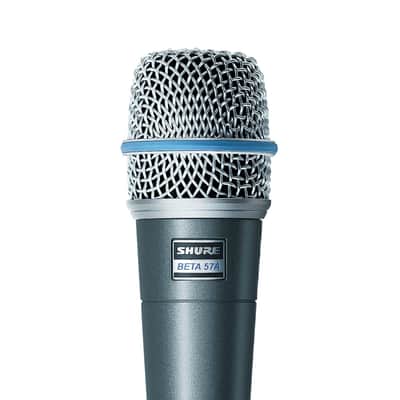
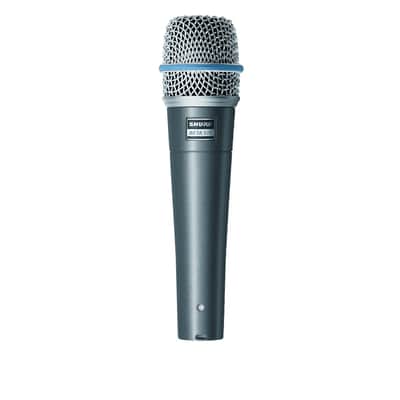
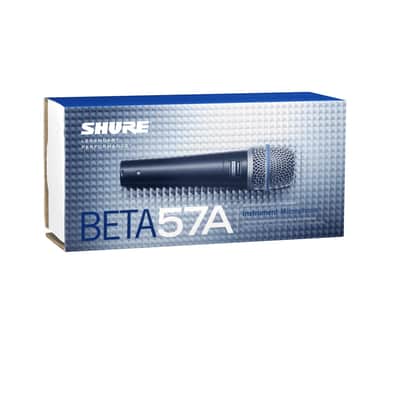
Shure Beta 57A Dynamic Instrument Microphone
This seller has not set a shipping cost for Canada. Please contact them to ask about shipping.


The Shure BETA 57®A is a precision-engineered, dynamic microphone designed for professional live sound reinforcement and studio recording. A tight, supercardioid pattern delivers high gain before feedback, maximum sound isolation, and minimum off-axis tone coloration.
The tailored frequency response of the versatile Beta 57A accentuates the fine details of amplified and acoustic instruments, especially in high sound pressure level(SPL) environments. A proven shock mount system, hardened steel-mesh grille, and superior build quality withstand the rigors of daily sound reinforcement.
Features- Premier live performance microphone with Shure quality, ruggedness, and reliability
- Uniform supercardioid pick-up pattern for maximum gain before feedback and superior rejection of off-axis sound
- Tailored frequency response specifically shaped for guitars, drums and vocals
- Neodymium magnet for greater sensitivity and higher output
- Advanced pneumatic shock mount system that minimizes transmission of mechanical noise and vibration
- Dent-resistant steel mesh grille and enamel coated die-cast metal construction resist wear and abuse
- Do not cover any part of the microphone grille with your hand, as this will adversely affect microphone performance.
- Aim the microphone toward the desired sound source (such as the talker, singer, or instrument) and away from unwanted sources.
- Place the microphone as close as practical to the desired sound source.
- Work close to the microphone for extra bass response.
- Use only one microphone to pick up a single sound source.
- For better gain before feedback, use fewer microphones.
- Keep the distance between microphones at least three times the distance from each microphone to its source (“three to one rule”).
- Place microphones as far as possible from reflective surfaces.
- Add a windscreen when using the microphone outdoors.
- Avoid excessive handling to minimize pickup of mechanical noise and vibration.
The following table lists the most common applications and placement techniques. Keep in mind that microphone technique is largely a matter of personal taste; there is no one “correct” microphone position.
Application Suggested Microphone Placement Tone Quality Guitar & Bass Amplifiers 2.5 cm (1 in.) from speaker, on-axis with center of speaker cone. Sharp attack; emphasized bass. 2.5 cm (1 in.) from speaker, at edge of speaker cone. Sharp attack; higher frequency sound. 15 to 30 cm (6 to 12 in.) away from speaker and on-axis with speaker cone. Medium attack; full, balanced sound. 60 to 90 cm (2 to 3 ft.) back from speaker, on-axis with speaker cone. Softer attack; reduced bass. Snare Drum 2.5 to 7.5 cm (1 to 3 in.) above rim of top head of drum. Aim mic at drum head. Most “snap” from drumstick. Tom-Toms One mic on each tom, or between each pair of toms, 2.5 to 7.5 cm (1 to 3 in.) above drum heads. Aim each microphone at top drum heads. On double head toms, you can also remove bottom head and place a mic inside pointing up toward top drum head. Medium attack; full, balanced sound. Brass & Woodwinds Brass: 30 to 90 cm (1 to 3 ft.) away, on-axis with bell of instrument. Bright, clear sound. Woodwinds: 2.5 to 15 cm (1 to 6 in.) away, on-axis with bell of instrument. Bright, clear sound. Bell of instrument 90° off-axis from front of mic. Softer, mellow sound. Avoiding Pickup of Unwanted Sound SourcesA supercardioid microphone has the greatest sound rejection at points 120° toward the rear of the microphone. Place the microphone so that unwanted sound sources, such as monitors and loudspeakers, are at these angles, not directly behind it. To minimize feedback and ensure optimum rejection of unwanted sound, always test microphone placement before a performance.
Recommended Loudspeaker Locations for Supercardioid Microphones
Proximity EffectUnidirectional (cardioid) microphones progressively boost bass frequencies by 6 to 10 dB below 100 Hz when the microphone is at a distance of about 6 mm (1/4 in.) from the sound source. This phenomenon, known as proximity effect, can be used to create a warmer, more powerful sound. To prevent explosive low frequency sound during close-up use, the bass response gradually rolls off. This provides greater control and helps the user take advantage of proximity effect.
Specifications TypeDynamic (moving coil)
Frequency Response50 to 16,000 Hz
Polar PatternSupercardioid
Output Impedance290 Ω
Sensitivityat 1kHz, open circuit voltage
-51 dBV/Pa (2 .8 mV)[1]
WeightNet
0.275 kg (0.6 lbs)
ConnectorThree-pin professional audio (XLR), male, balanced
HousingSilver blue enamel-painted die cast metal with hardened, matte-finished steel mesh grille
[1] 1 Pa=94 dB SPL
Overall Dimensions
Typical Frequency Response
Typical Polar Pattern
Wiring Diagram
Accessories Furnished AccessoriesMicrophone Clip for SM58, SM57, SM87A, Beta 87A, Beta 87C, PGA57, PGA58, PGA48, PGA81
A25D
5/8" to 3/8" (Euro) Threaded Adapter
95A2050
Zippered Carrying Bag
95A2314
Optional AccessoriesBlack Locking Foam Windscreen for BETA 57 and BETA 57A
A57AWS
Shock Stopper® Isolation MountA55HM
25 foot (7.5m) Triple-Flex® Microphone XLR Cable with Switchcraft connectors
C25E
Replacement PartsCartridge for BETA 56, BETA 56A, and BETA 57A
R174
Grille for BETA 56A and BETA 57A
RK320
Plug (Connector) Assembly
90J1984
Thank you for visiting our Reverb shop. Feel free to contact the shop directly for more information and deals!
| Condition | Brand New (New) Brand New items are sold by an authorized dealer or original builder and include all original packaging.Learn more |
|---|---|
| Brand | |
| Model |
|
| Categories |
Product safety information may be available here.

