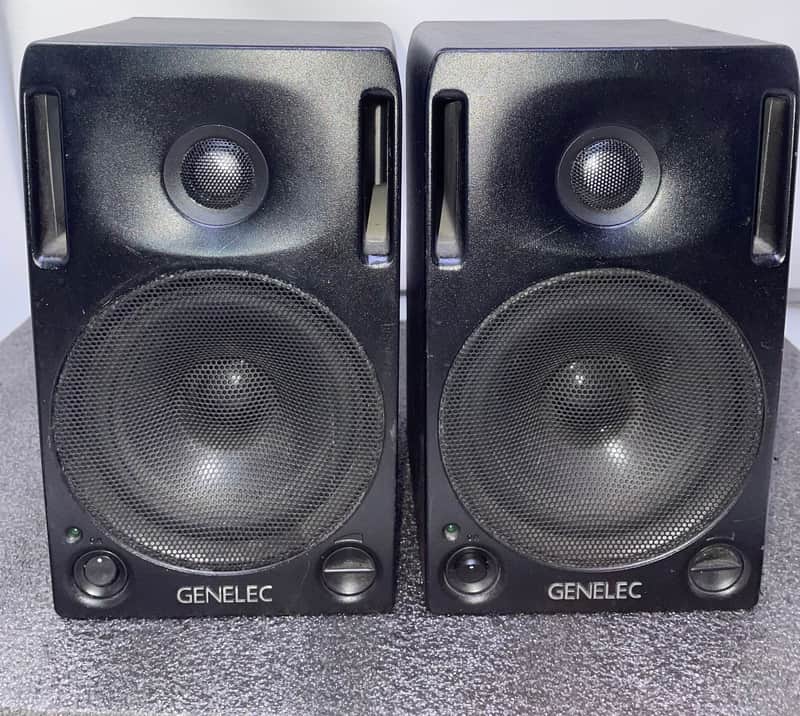

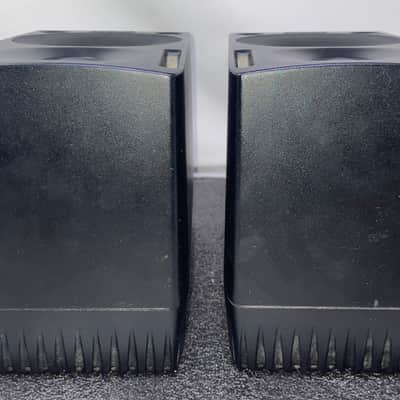
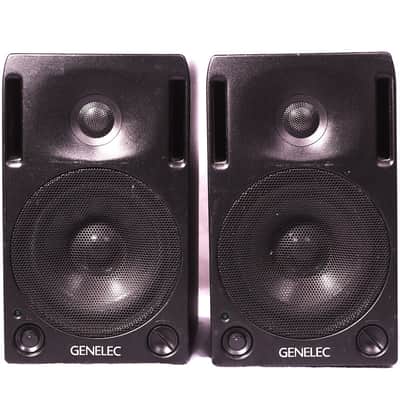
Genelec 1029A 5" Powered Nearfield Studio Monitor (Pair) 1996 - 2005 - Black
This seller has not set a shipping cost for Belgium. Please contact them to ask about shipping.


Our users rate Reverb
Pair of Genelecs I purchased in 1997, climate controlled studio environment only. These are marvelous near field monitors that have served me well for almost 30 years.I will ship professionally packed UPS flat rate insured within the contiguous USA.
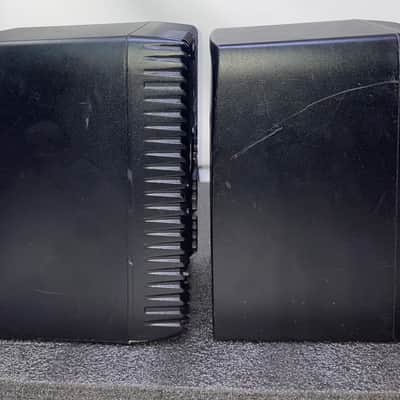
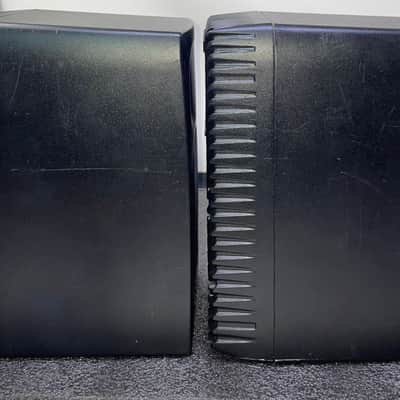
The extremely compact 1029A is a powerful bi-amplified nearfield monitor system ideal for project and home studios, digital workstations, and surround sound monitoring. The monitor has a very rugged cast aluminium construction and magnetic stray field shielding as default for every single unit. Vented speaker enclosure contains an amplification unit, including an active electronic crossover, overload protection circuitry and two power amplifiers, one for each driver.
Genelec's unique Directivity Control Waveguide™ (DCW™) is used to provide excellent stereo imaging and frequency balance, even in difficult acoustic environments. Versatile room response controls allow matching of the system to its surroundings. If very large sound level and low cutoff frequency are required it can be complemented with the 7050A subwoofer.
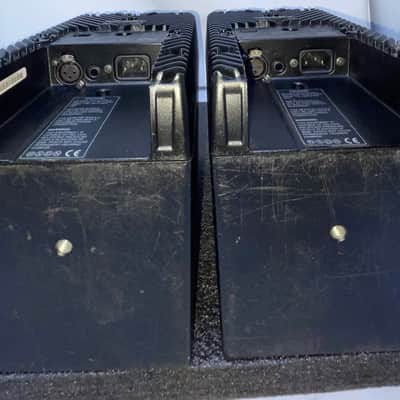
The 1029A is very easy to set up and use, the only connections required are the mains supply and the line level input. The input is made via balanced XLR female or 1/4" jack socket connector which can also be used in parallel.
The 1029A/1091A combination is a TEC (Technical Excellence & Creativity) 1997 award winner for Studio Monitor Technology, and PAR (Pro Audio Review) Excellence award winner.
The 1029A was in production between 1996 and 2005.
From Sound on Sound-
I don't know if it's a Scandinavian trait, but Genelec like to give all of their monitors very boring (and often confusing) numeric identifications. The 1000 series all share a similar look, with a narrow vertical ported vent on each side of the tweeter, which is at the focus of a subtle convexed surface, called the DCW (Directivity Control Waveguide).
The smaller the Genelec monitor number, the smaller the cabinet size, and the 1029A is the smallest of Genelec's current offerings, with a cabinet measuring 247mm (h) x 151mm (w) x141mm (d). The 'A' at the end of the number simply indicates the active nature of the monitor, with two 40W amplifiers and line‑level crossover built in.
The speakers are astonishingly heavy, weighing in at 5.7kg, largely thanks to the unusual use of cast aluminium in the cabinet, but the large amplifier heatsink and the standard magnetic shielding probably contribute significantly to the weight as well.
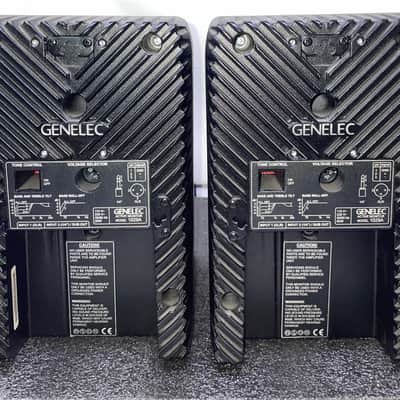
Mounting the 1029As is a doddle, since three fixing options are provided as standard. The heatsink on the rear panel is equipped with three keyhole slots which accept 4mm large‑headed screws for wall mounting, as well as fixing points for a standard Omnimount wall bracket. The base of the speaker also has a <sup>3</sup>/8‑inch UNC threaded hole, which allows the speaker to be fixed to the top of a mic stand.
The 1029A has two drivers, a 5‑inch woofer and a <sup>3</sup>/4‑inch tweeter. The woofer is capable of handling signals down to a very respectable (for the cabinet size) 65Hz, thanks to the active equalisation and the ported 4.5‑litre cabinet. The tweeter is mounted at the focus of the aforementioned DCW, which is used to give a uniform high‑frequency dispersion, and also to improve the performance of the complete system at the crossover between the two units.
The active crossover uses a pair of complementary band‑pass filters with slopes between 24 and 32dB/octave, the lower section passing frequencies between 68Hz and 3.3kHz while the upper section handles 3.3kHz to 25kHz. The outputs from the crossover are passed to a pair of 40W amplifiers, which drive the loudspeakers directly.
The amplifier design has very low distortion (0.08%) and fast slew rates, and is fully protected to avoid overloading the drive units. I was amazed to discover the sound‑pressure figures for the 1029A, which suggest that they are capable of generating peak levels of 110dB SPL at 1 metre on typical musical material, with an even more amazing long‑term RMS output of 98dB SPL! These are impressive figures for such a diminutive loudspeaker, and ones which confirm the ruggedness of the design.
Audio Connections
The rear panel has three sockets, two for analogue audio and the third for the mains. A standard IEC mains socket is accompanied by a voltage selector switch, and a moulded mains cable is supplied (although in the case of the review model, these were of 2‑pin European design). The input and mains sockets are all arranged so that the leads hang vertically downwards, which will allow the speaker to be mounted on the wall very easily. Although the XLR is latching, and the TRS is pretty solid, I'm not so sure that the IEC mains lead will remain in place for ever — perhaps a retaining clip would have been a good idea.
The two audio sockets are both balanced, one a 3‑pin XLR and the other a quarter‑inch TRS jack. Although balanced connections are preferred, unbalanced operation is possible, provided the plugs are wired to connect the cold side of the balanced audio circuit and the earth together. As with other Genelec products, the rear panel has plenty of silk‑screened information about connector wiring and so forth, so even after you have lost the instruction leaflet, the key information is still available.
Either of the two sockets on the rear of the 1029A may be used as an input in a stand‑alone mode, although when it's partnered with the 1091A sub‑woofer, the XLR is taken as the input, and the TRS jack provides the onward connection to the sub‑woofer. This aspect of the design differs from that of the larger Genelec systems, which route the audio through the sub‑woofer first (for low‑frequency filtering), before passing it to the satellite speakers.
Aside from the dip switches (see the 'Dip Dip Dip' box elsewhere in this article), all the 1029As' controls are on the front panels, and consist of a circular rocker switch to turn the unit on, and a rotary level control to set the input sensitivity. There are no calibrations on the volume control, so matching a pair of 1029As is a matter of trial and error; but they will accept a wide range of input levels, which makes matching to professional or semi‑pro equipment very straightforward.
1091A Sub‑Woofer
The 1091A sub‑woofer is specifically designed to work with the 1029As. It is surprisingly compact at 505mm (h) x 251mm (w) x 230mm (d), and is finished in black with the amplifier heatsink on the top surface between a pair of large slotted port openings. The amplifier heatsink appears to be identical to that of the 1029A, and even has the same mounting options (none of which may be used, of course — the 1091A is strictly a floor‑mounted device!). Most installations would probably have the sub‑woofer standing upright with the vents facing upwards, but an acceptable alternative is to have the box lying down with the ports firing out to the side.
The sub‑woofer uses a single 8‑inch bass driver which is installed in a 15‑litre ported cabinet, the whole system handling the frequency range between 38Hz and 85Hz. The amplifier unit is configured as a 70W unit with the same protection circuitry to look after the drive unit and similar performance figures. The maximum sound pressure level that the 1091A can achieve is 103dBA — more than enough to have the walls shaking!
The electronic crossover uses a 24dB/octave filter above the crossover frequency (85Hz), and has an 18dB/octave filter below about 40Hz to remove subsonic signals which would merely sap amplifier power without producing useful audible output.
Audio connections are the same as on the satellite speakers, with an XLR and TRS jack, and both are again balanced, of course. This is my only real area of complaint for the entire system, since it requires a rather strange collection of interconnecting leads. The inputs to the satellite 1029As are on XLRs, but one sub‑woofer feed requires a TRS‑to‑XLR (m) lead, while the other needs a TRS‑to‑TRS lead. Not really a problem, I suppose, but it was an initial frustration to me because all my balanced leads use XLRs, and I had to make up some converters before I could get the system going. Perhaps Genelec (or UK distributors Project Audio) could consider supplying a suitable set of leads with the sub‑woofer?
The sub‑woofer is a doddle to set up, especially since the most effective thing to adjust is its physical position in the room. A set of DIP switches allows the input sensitivity to be balanced to the satellites over a 12dB range, which helps to compensate for the bass‑boosting effects of placing the sub‑woofer near walls or corners. The instruction leaflet gives very good and clear advice on how to position the sub‑woofer; I found its most effective location to be lying parallel to a wall between the two satellites with about 6 or 8dB of gain attenuation.
I knew from previous experience with Genelec monitors that you have to be very careful about matching levels between the satellites and sub‑woofer (although this applies to all satellite/sub‑woofer systems). It is very easy to set the system up with impressive but excessive bass output — the end result of which will be mixes that sound thin and bass‑light on other monitoring systems. Remember, the sub‑woofer should not draw attention to itself if it is properly set up, but switching it off will make its contribution clear! The other things to watch out for are peaks or dips at the crossover frequency. The supplied instruction leaflet explains how to match the units properly by adjusting the polarity of the sub‑woofer to ensure that its signal is in the same polarity as the main speakers. This is simple to do, but has a profound effect on the end results.
When everything is set up, I like to listen to tracks that have 'walking' bass guitar lines to check the overall performance. The bass guitar should sound equally loud whatever notes are played, without any obvious loud or quiet pitches. Inevitably, the room itself will make this almost impossible to achieve because of standing waves (or Eigentones) where the room's dimensions relate to specific wavelengths and the whole room effectively resonates at those frequencies. Moving the sub‑woofer or listening position a foot or so can often make dramatic improvements to these standing waves, so experimentation is very important in getting the best possible results.
The advantage of satellite/sub‑woofer systems is that, by divorcing the bass driver from the rest of the system, you can find the best in‑room position for the sub‑woofer without compromising the stereo imaging (and vice versa). This is just not possible with full‑range stereo loudspeakers, where the position for best imaging often puts the bass drivers at inappropriate positions in terms of standing waves in the room.
Performance
These baby Genelecs are quite simply stunning! I have always been a fan of the Genelec sound, which is clean, neutral, accurate and well‑balanced — everything a decent monitor loudspeaker should be. The 1029/1091 combination certainly lives up to the reputation of its larger and more costly siblings, yet in a surprisingly small package.
You really have to hear these diminutive loudspeakers in action to believe the scale and quality of the sound they generate. Stereo imaging is crystal clear, very precise and stable over a reasonably wide working area, with good depth and width. When they were set up as nearfield monitors, the sound stage extended well behind the monitors, and gave a very creditable, almost three‑dimensional quality to the music. When they were set with a flat frequency response, I found the 1029As a little too 'sharp' for my tastes — not obviously bright or 'tizzy', just too detailed or analytical, perhaps. Many of you will probably think them fine when set to flat response, but after years of listening to rather smooth BBC‑designed loudspeakers, I found the ‑2dB treble tilt a more acceptable balance for my tastes. In this condition, the speakers were just as tonally correct and precise, and still capable of revealing technical flaws in recordings, but less fatiguing and generally easier to work with over long periods. Although the 1029As tend to sound a little bass‑light on their own (and I would definitely recommend they be used with the matching sub‑woofer), they still managed to produce a very creditable sound, given their overall size and power rating.
Apart from the bass roll‑off setting needed to match the satellites to the sub‑woofer, I found no need for the bass tilt settings, although I'm sure they would be useful if the speakers were mounted close to rear walls. When the optimum position had been found for the sub‑woofer, the bass integrated seamlessly and provided a very solid foundation for any instrument with a low‑frequency content. Percussion of all kinds gained a weight and solidity from the 1029A/1091 system, and even singing voices became much more natural and believable — it is surprising what an enormous difference the extra octave at the bottom makes!
A good indicator of the quality of a monitoring system is how loud it actually has to be before you perceive it as being loud. Our brains use the distortion content of the signal as a measure of the actual loudness — the cleaner the source, the louder we will listen. The 1029As have no problem on this front: what appeared to be a comfortable listening level turned out to make conversation difficult and the system was quite capable of making all manner of things in the control room rattle when turned up. Even though these monitors are small, they can produce a very big sound indeed. In short, the 1029As are easy to install and simple to set up, and provide performance which is little short of stunning. If you are in the market for a monitoring upgrade, these need to be at the top of your shopping list!
Dip Dip Dip...
Buried deep within a well in the heatsink are four DIP switches which set the bass roll‑off (for use with the sub‑woofer), and allow bass and treble tilt equalisation to suit personal taste and to compensate for the physical installation. Although I realise that these switches will be rarely used after the installation phase, I did find them rather tricky to adjust. You will need a long thin screwdriver, some good lighting and a steady hand!
One of the switches introduces a bass roll‑off below about 100Hz, which is only intended for use with the matching sub‑woofer. Two other switches activate three levels of bass reduction in 2dB steps (from about 1kHz downwards), and the last switch tames the treble slightly, with a 2dB shelf downwards from about 5kHz. In my own circumstances, I found the system easier to live with once the treble tilt had been selected.
Pros
- Fantastic sound quality given size and price, with accurate and revealing nature.
- Good detailed stereo imaging.
- Integrates well with matching sub‑woofer.
- Well thought‑out mounting options.
Cons
- Satellites sound lightweight on their own.
- No level calibration marks.
This item is sold As-Described
This item is sold As-Described and cannot be returned unless it arrives in a condition different from how it was described or photographed. Items must be returned in original, as-shipped condition with all original packaging.Learn More.
| Listed | 4 days ago |
|---|---|
| Condition | Good (Used) Good condition items function properly but may exhibit some wear and tear.Learn more |
| Brand | |
| Model |
|
| Finish |
|
| Categories | |
| Year |
|
| Made In |
|
| Amplification |
|
| Electronics |
|
Product safety information may be available here.

