




Our users rate Reverb
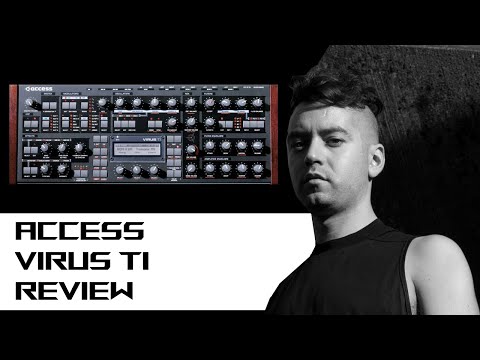
The Access Virus TI (1st Gen) Desktop represents an exceptional value-for-money purchase compared to the TI2 Desktop. Because Access Music kept the underlying sound engine and software capabilities identical between both generations, the 1st Gen offers roughly 95% of the experience for a significantly lower price.
Why the 1st Gen is the Ultimate "Value for Money" Choice:
1. Identical Sonic DNA
The TI1 and TI2 sound completely identical. Access did not change the digital-to-analog converters (DACs) or rewrite the filters for the TI2. Every waveform, wavetable, filter algorithm, and modulation routing block is exactly the same. A patch created on a TI2 will load and sound identical on a 1st Gen TI.
2. The 25% DSP
The main upgrade in the TI2 is a 25% boost in DSP processing power. While this sounds significant on paper, the Virus dynamic voice allocation means both units suffer from voice-stealing if you stack multiple heavy Unison patches, Reverbs, and Delays in Multi-mode. The 25% headroom on the TI2 only grants you a few extra voices in high-stress scenarios—it does not fundamentally change how you produce music.
3. Total Integration (TI) Equality
Both devices use the exact same operating system updates. Features added later in the lifecycle (like the Atomizer or new distortion models) were rolled out to both units simultaneously.
Core Architecture & Performance:
- Sound Engine: Dual-DSP hardware platform running entirely identical firmware across the 1st Gen lineup.
- Polyphony: Dynamic voice allocation scaling from 20 to approximately 80+ voices. Actual polyphony is patch-dependent based on the complexity of oscillators and active effects.
- Multi-timbral Capability: 16-part multi-timbral mode with independent settings for all 16 channels.
Memory & Preset Patches:
- RAM Patches: 512 fully rewritable user patch locations.
- ROM Patches: 3,328 factory-burned, un-erasable read-only presets.
- Multi-Mode Memory: 16 embedded Multi-mode slots (which copy and save the full underlying patches directly into the multi-setup) plus an additional 112 reference-based Multi-mode slots.
Synthesis Engines:
- Oscillator Types:
- Classic Virtual Analog: Sawtooth, pulse (with PWM), triangle, sine, and variable waves.
- Hypersaw: Generates up to 9 parallel sawtooth waves per voice with integrated sub-oscillators.
- Wavetable: 72 distinct wavetables featuring advanced interpolation.
- Grain & Formant Table: Granular synthesis options for complex textures and vocal formants.
- Filters: Two independent multi-mode filters (low-pass, high-pass, band-pass, band-reject) configurable in series or parallel, alongside an accurate emulation of the Moog 4-pole cascade filter.
- Modulation: 3 LFOs with 68 waveforms, 2 fast ADSTR envelopes, and a 6-slot Modulation Matrix(each slot holding 1 source and 3 independent targets).
- Arpeggiator: A programmable, 32-step arpeggiator engine per multi-timbral part.
Onboard Effects (Per Multi Part):
- Dedicated FX Chains: Up to 192 parallel effects processing paths.
- Per-Part Independence: Unlike traditional synths, each of the 16 parts gets its own dedicated:
- Reverb and Delay
- Distortion/Lo-Fi degradation modules
- Phaser, Flanger, and Chorus
- 3-band parametric Equalizer
- Vocoder routing and Analog Boost
Physical Connections & Controls:
- Analog Audio Outputs: 6 balanced mono phone jacks (3 stereo pairs) running studio-grade 24-bit / 192kHz Digital-to-Analog converters.
- Analog Audio Inputs: 2 studio-grade, balanced inputs for running external audio through the filters and effects blocks.
- Digital I/O: Coaxial S/PDIF Input and Output (supporting 44.1kHz and 48kHz operations).
- MIDI: Traditional 5-pin MIDI In, MIDI Out, and MIDI Thru.
- USB: Single USB 1.1 Type-B port operating at 12 Mbit/sec Full Speed. Used for Total Integration data stream, MIDI over USB, and simultaneous 4-in/2-out audio streaming.
- Display & Front Panel: 128x32 pixel graphics display with white backlight text. Outfitted with 32 tactile potentiometers, 43 function buttons, and 3 assignable soft-knobs below the display.
- Chassis Design: Pure all-metal construction with mahogany side panels, red diagnostic/tempo LEDs, and an I/O backplate capable of rotating 90 degrees for low-profile 19-inch rack installation.
This item is sold As-Described
This item is sold As-Described and cannot be returned unless it arrives in a condition different from how it was described or photographed. Items must be returned in original, as-shipped condition with all original packaging.Learn More.

| Listed | 12 hours ago |
|---|---|
| Condition | Excellent (Used) Excellent items are almost entirely free from blemishes and other visual defects and have been played or used with the utmost care.Learn more |
| Brand | |
| Model |
|
| Finish |
|
| Categories | |
| Year |
|
| Made In |
|
| Polyphony |
|
| MIDI I/O |
|
| Analog / Digital |
|
Product safety information may be available here.


