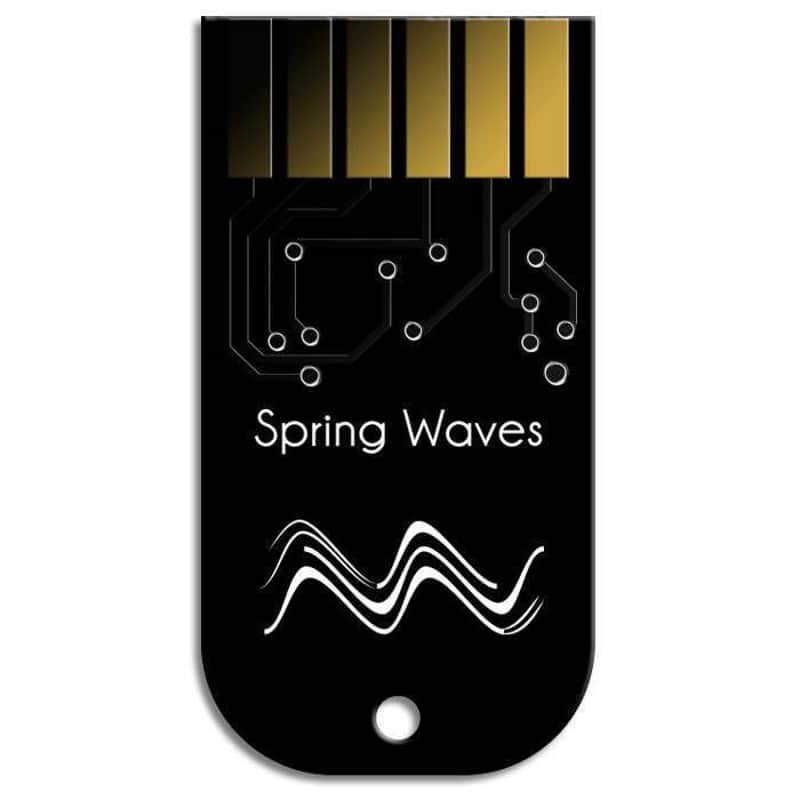
TipTop Audio ZDSP Spring Waves Cartridge

Only 1 left
Grab it before it's gone


14-Day Return Policy
Enjoy peace of mind with your new gear
The delay time determines the pitch and the feedback determines the decay time. Digital waveguides combine and connect together a number of these algorithms.
This model calculates at the sampling rate all of the Newtonian forces controlling the behaviour of a mass-spring system, and takes into account the following factors: the spring itself and its return force (with a potentially non linear behaviour), a point where one side of the spring is attached, a mass attached on the other side, fluid friction depending on the speed of the mobile mass, mechanical limits (a physical spring can’t stretch out infinitely) and static and dynamic frictions (friction due to the contact with a rough surface).
The audio input is used either to “move” the point where one side of the spring is attached, or as force directly applied to the moving mass on the other side. The audio output is directly provided by the motion of the moving mass.
Common controls:
Waveguide models ( the first six ones): L+R inputs can be used same way. Control 1 defines pitch, Control 2 is damping the sound.
Spring models (the last two): left input is regular input, right input is an alternate input. Control 1 is the hardness of the spring, similar to frequency of a filter; Control 2 is the Fluid Friction, slowing down the mass, similar to a filter resonance.
Programs:
- Double Waveguide Mixed: two waveguides which are mixed and then fed back. Pitch adjustable separately.
- String Waveguide: Waveguide simulating a plucked string. Pitch of both waveguide is controllable individually.
- Bass Waveguide: Specialized on bass processing. PitchEnv controls depth of the envelope follower modulating the waveguide pitch.
- Minor Chords: Four waveguides, three of them are tuned to a minor chord. The fourth can be tuned to a fourth, minor seventh, seventh or octave with Chord.
- Waveguide Mesh 1: Four waveguides with frequency spread, which is controlled with Spread.
- Waveguide Mesh 4: Like program #5 but the waveguides are interconnected.
- Spring Filter 3 (LP): Spring model resembling a lowpass lowpass. Force sets the spring's force, Friction the amount of friction (like inverse resonance), Lin-3 at the same time the linearity of spring hardness and friction.
- Static Friction 2: Spring model with static friction. Great for destroying and crunching sounds. Force and Friction see above, Static controls amount of static friction (the higher the more it will scratch).
| Condition | Brand New (New) Brand New items are sold by an authorized dealer or original builder and include all original packaging.Learn more |
|---|---|
| Brand | |
| Model |
|
| Finish |
|
| Categories | |
| Year |
|
Product safety information may be available here.

