For players of a certain age, the name Realistic immediately brings to mind aisles of radios, cassette decks, and home stereos at RadioShack. In the early ’80s, the brand quietly released the Realistic Electronic Reverb—a piece of consumer gear that was never meant for guitarists, yet has since earned a cult reputation among players who like their tone a little unconventional.
Despite its name, the unit isn’t really a reverb at all. It’s a short analog bucket-brigade delay designed to live inside a home stereo setup, complete with RCA connections and a single 1/4-inch input that opened the door for guitar players to start experimenting. The controls are almost laughably simple—input level, delay, repeat, and mix—and the delay itself stays firmly in slapback territory, never drifting into long repeats or self-oscillation.
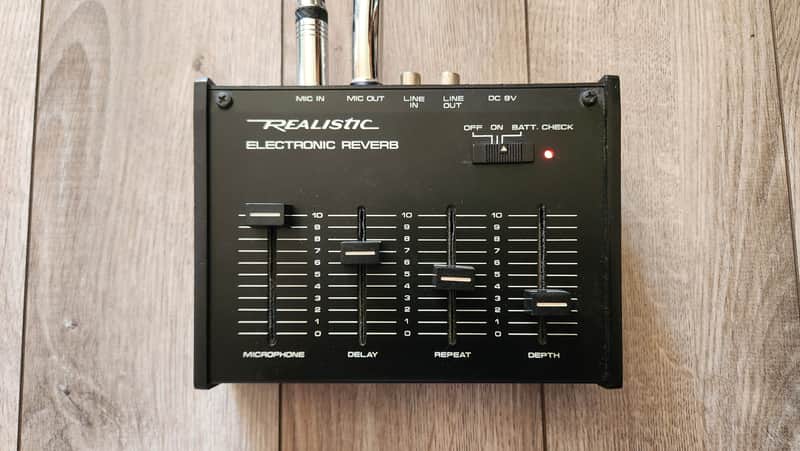
But the charm isn’t in how much it does—it’s in how it breaks. Push the input level and the circuit slips into a gritty, unusual overdrive that feels closer to misused studio gear than any traditional pedal. It’s raw and reactive, with a string attack that stays intact even as the sound roughs up around it. This isn’t a first overdrive, and it’s not especially polite, but it’s undeniably characterful.
The Realistic Electronic Reverb works because it’s limited. There’s no bypass, no presets, and no safety net—if you’re plugged in, it’s on. Those constraints encourage quick decisions and often lead to unexpected results. It’s also a reminder of what can happen when gear built for one purpose finds a second life somewhere else. Consumer electronics and musical expression have always collided in interesting ways, and this odd little box is a perfect example.
You don’t see the Realistic Electronic Reverb pop up for sale very often, and with RadioShack long gone, finding one today usually means keeping an eye on the used market. When they do surface, Reverb is often the place they land—so add it to your Feed to be notified when one is listed.