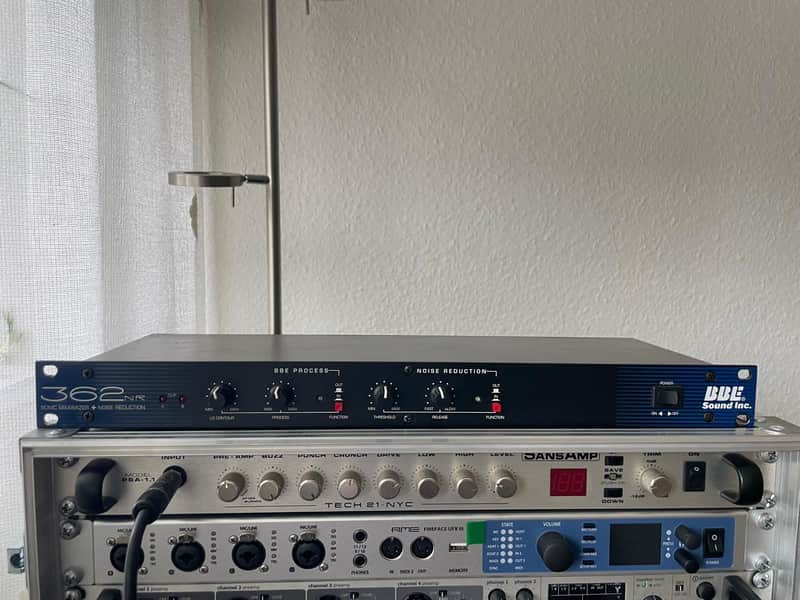
BBE 362 NR Sonic Maximizer + Noice Reduction



Great Value
Our users rate Reverb
BBE's new Sonic Maximizer combines enhancement with single‑ended noise reduction. Paul White finds out whether the marriage of the two systems is a happy one.
As most regular SOS readers will know, BBE's patented process is a means of enhancing an audio signal to improve the sense of detail and transparency, but unlike the Aphex system, which is based around harmonic synthesis, BBE's is more concerned with redistributing the harmonics that are already present. Apparently, the process was first devised to counteract the phase smearing that occurs in typical passive loudspeaker systems. It does this by breaking the audio spectrum down into three bands, then applying small delays to the lower two bands. The signal is delayed by around 2.5mS between 20Hz and 150Hz, whereas mid‑range signals between 150Hz and 1200Hz are delayed by just half a millisecond. Above 1200Hz, the signals are not delayed, but are subjected to some form of dynamic amplitude control which has the effect of emphasising high‑frequency, transient detail. As heavy processing can cause the top end to overpower the bottom end, a low‑frequency equaliser permits the user to add boost at 50Hz to compensate.
It's well proven that all types of enhancer can make a significant contribution to musical clarity, but because all increase the amount of high frequency energy in the signal, albeit slightly, there's always the risk of emphasising any noise already present in the input signal. Many people, including myself, have at some time or other used a combination of enhancer and single‑ended noise reduction to clean up master recordings or sweeten old mixes, and now BBE have taken the step of combining both processes in a single 1U box.
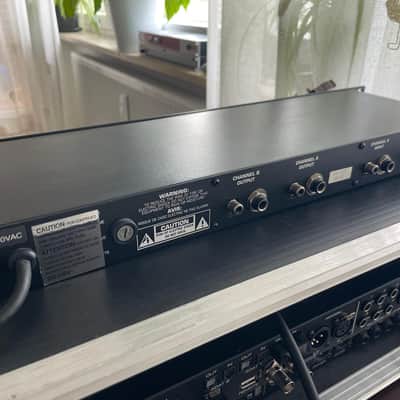
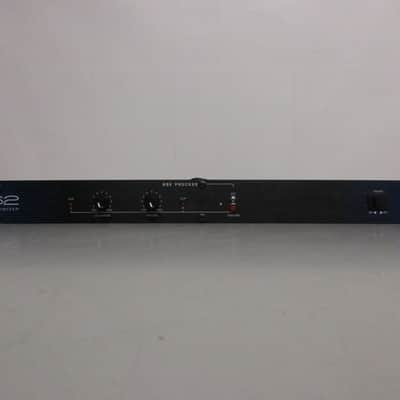
The BBE 362NR is a dedicated stereo unit with ganged controls, and is optimised for ‑10dBV applications. Jack and phono In/Out connectors are provided, both offering unbalanced operation only. The DNR (dynamic noise reduction) circuit comes right at the end of the signal chain before the output sockets, and is actually very simple, being based around a frequency‑conscious envelope follower, which in turn controls an LED/LDR combination. The LDR (light dependent resistor) forms part of a straightforward RC (resistor/capacitor) filter, and as the resistance changes, so does the roll‑off frequency of the filter. In practice, as the signal level falls to the point where noise might become a problem, the filter starts to close, removing progressively more of the high frequencies which, in most cases, should be mainly noise. The BBE part of the circuit is handled by BBE's proprietary chip.
This item is sold As-Described
This item is sold As-Described and cannot be returned unless it arrives in a condition different from how it was described or photographed. Items must be returned in original, as-shipped condition with all original packaging.Learn More.
| Listed | an hour ago |
|---|---|
| Condition | Very Good (Used) Very Good items may show a few slight marks or scratches but are fully functional and in overall great shape.Learn more |
| Brand | |
| Model |
|
| Categories |
Product safety information may be available here.