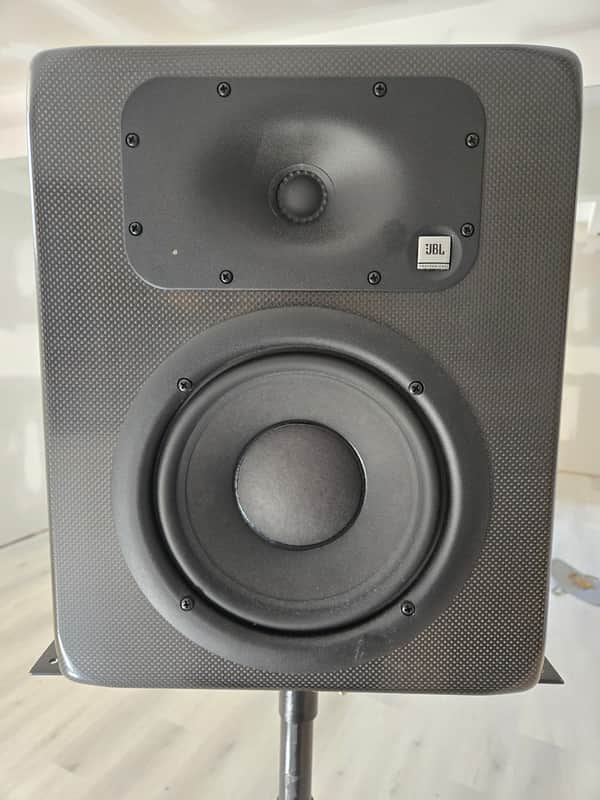
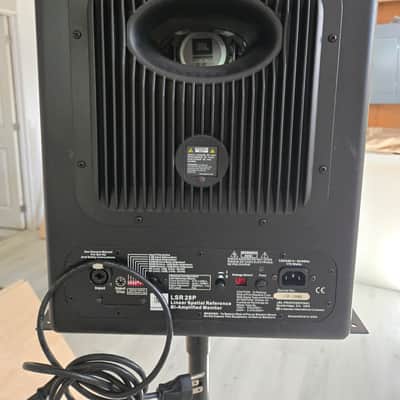
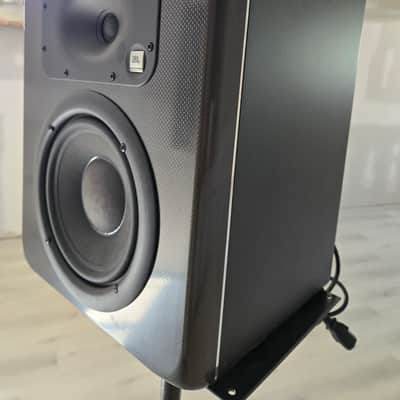
JBL LSR28P Studio Reference Monitors

Our users rate Reverb
The JBL LSR28P is a bi-amplified near-field studio monitor featuring an 8-inch Differential Drive woofer and a 1-inch titanium composite tweeter with an Elliptical Oblate Spheroidal (EOS) waveguide, powered by 250W for the low-frequency and 120W for the high-frequency drivers. Key specifications include a frequency response of 50 Hz – 20 kHz, a 1.7 kHz crossover frequency, and dimensions of 406 x 330 x 325 mm (16 x 13 x 12.75 in.). Technical Specifications
- Driver Components:
- Low Frequency: 8-inch JBL 215F (or 218F) Differential Drive® woofer
- High Frequency: 1-inch JBL 053Ti titanium composite tweeter
- Amplification: Bi-amplified with a 250-watt amplifier for the LF and a 120-watt amplifier for the HF
- Frequency Response: 50 Hz – 20 kHz (+1, -1.5 dB)
- Crossover Frequency: 1.7 kHz
- Sensitivity: 96 dB @ 1 Meter (XLR input: +4dB)
- Dimensions: 406mm x 330mm x 325mm (16 x 13 x 12.75 in.)
- Weight: 22.7 kg (50 lbs)
- Impedance: 4 ohms
- Enclosure: Rear-ported with a 50-liter net volume, featuring a carbon fiber composite baffle and an integrated Linear Dynamics Aperture
- Waveguide: Elliptical Oblate Spheroidal (EOS) waveguide with a 100 x 60 degree dispersion angle .
The LSR28P Linear Spatial Reference Studio Monitor combines JBL’s transducer and system technology with breakthroughs in psychoacoustic research to provide a more accurate studio reference. The Linear Spatial Reference (LSR)philosophy is based on a set of design goals that carefully control the overall performance of the system in a variety of acoustic spaces. Instead of focusing on a simple measure such as on-axis frequency response, LSR designs require much better control over dispersion via transducer selection and crossover frequency design. Critical decisions of image placement, EQ, balance and timbre are typically made within +/- 15° vertically and +/- 30° horizontally. This workspace is where the engineer, producer and artist make critical mixing decisions and this is the area that LSR is optimized for superb in room response. By incorporating LSR into the system design requirements, placement rules are relaxed, a more stable stereo image is maintained and off-axis coloration is minimized.
* Linear Spatial Reference design based on spatial response measurements and psychoacoustic principles.* Differential Drive® Technology with dynamic braking for extended low frequency response and low power compression.* Integrated Bi-amplification with calibrated and variable sensitivities. * Titanium Composite High Frequency Device with Elliptical Oblate Spheroidal Waveguide and Damped Pole Piece. * Carbon Fiber Composite Baffle for low cabinet resonance and stable inertial ground. * Linear Dynamics Aperture Port Design eliminates port noise andreduces port compression.
REVIEW FROM SOUND ON SOUND:
"I found the monitors' stereo imaging and presentation of depth to be very fine indeed, giving a very realistic portrayal of stage depth with appropriate material, and revealing the spatial relationships of instruments with great precision in pan‑potted and coincident mic recordings. The LSR28P is certainly capable of generating powerful sound pressure levels (up to 110dB SPL, apparently) without obvious signs of distortion or fatigue — in fact, distortion levels are extremely low throughout the frequency range and even at high levels, which is a very good sign of a competent loudspeaker. These monitors don't sound loud even when they are being driven hard, which can be a problem when you try to have a conversation with someone, and is a sure indication that distortion levels are extremely low!
One of the things that most impressed me about the LSR32s was their superb mid‑range clarity, which could reveal every nuance of a particularly challenging piece of Vivaldi...
The integration between the tweeter and bass/mid‑range unit was excellent, and moving up and down in front of the speaker did not reveal any nasty suck‑outs or peaks in the output — the LSR technique has clearly delivered the goods here! The overall sound balance is commendably flat, and the plots show the frequency response to be extremely accurate, although I detected a slight tendency towards 'pluminess' in speech, particularly on female spoken and singing voices. There's plenty of power at the bottom end, and the LSR28Ps are capable of generating trouser‑flapping bass with the right material, although they could lack clarity and detail, tending to become thumpy in complex mixes. One of the things that most impressed me about the LSR32s was their superb mid‑range clarity, which could reveal every nuance of a particularly challenging piece of Vivaldi I like to use on my speaker tests."
This item is sold As-Described
This item is sold As-Described and cannot be returned unless it arrives in a condition different from how it was described or photographed. Items must be returned in original, as-shipped condition with all original packaging.Learn More.
| Listed | a year ago |
|---|---|
| Condition | Mint (Used) Mint items are in essentially new original condition but have been opened or played.Learn more |
| Brand | |
| Model |
|
| Finish |
|
| Categories | |
| Year |
|
| Made In |
|
Product safety information may be available here.